Skip to content
  • Home
  • AHSA
    • AHSA Inc. Meetings
    • AHSA Inc
      • AGM 2022
    • AHSA (NSW) Inc.
    • AHSA (QLD) Inc.
    • Privacy Policy
    • Disclaimer
  • Publications
    • Aviation Heritage
    • Aviation Heritage Web Archive
    • AHSA Newsletter Archive
  • Members
    • Members Only
  • Books
  • Join
  • Links
  • Store
  • Log In
    • My Membership Account
Aviation Historical Society of Australia
  • Home
  • AHSA
    • AHSA Inc. Meetings
    • AHSA Inc
      • AGM 2022
    • AHSA (NSW) Inc.
    • AHSA (QLD) Inc.
    • Privacy Policy
    • Disclaimer
  • Publications
    • Aviation Heritage
    • Aviation Heritage Web Archive
    • AHSA Newsletter Archive
  • Members
    • Members Only
  • Books
  • Join
  • Links
  • Store
  • Log In
    • My Membership Account

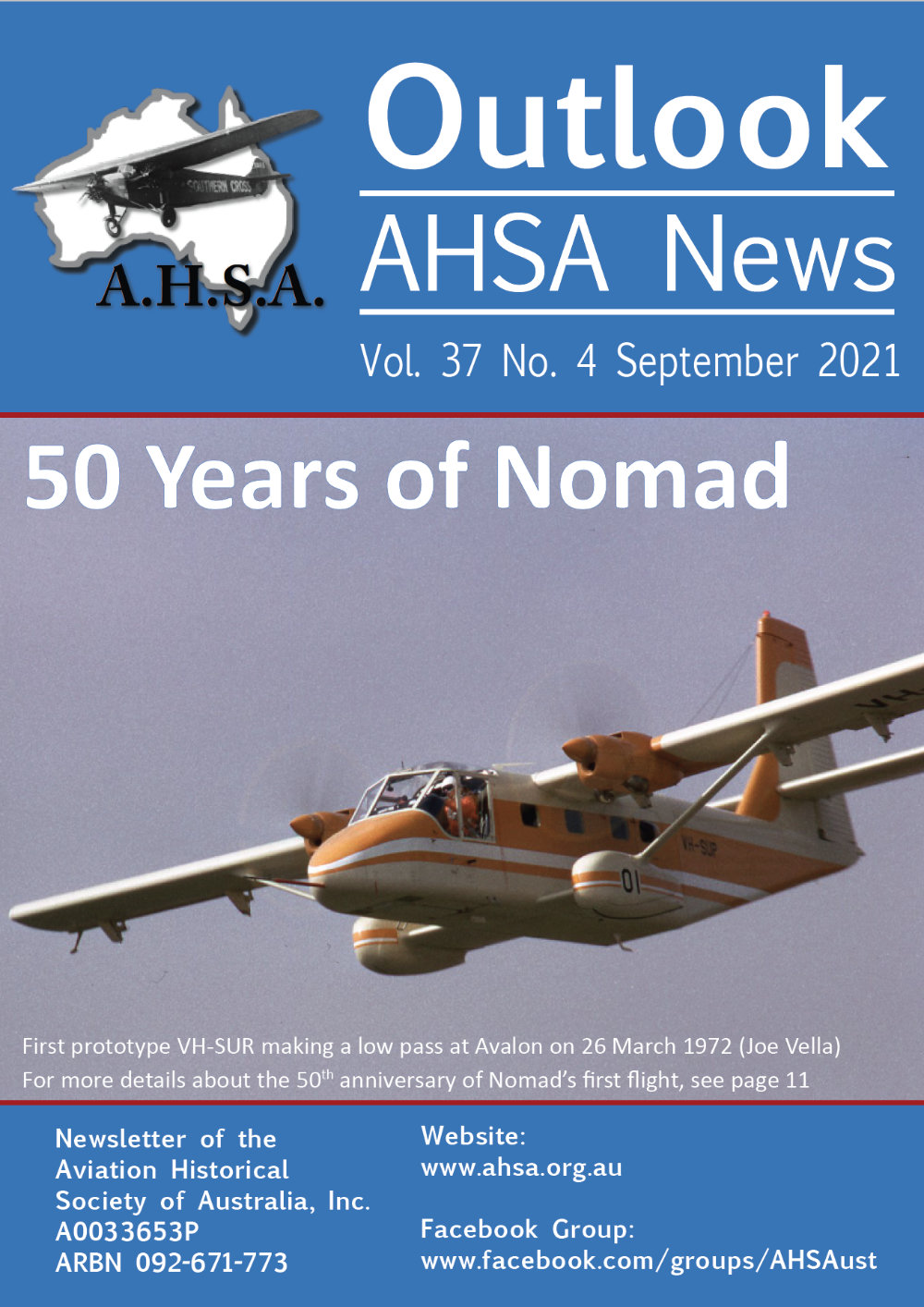
September 2021 Outlook Newsletter

DerekB07/10/202113/12/2021

The September 2021 edition of the Outlook AHSA Newsletter has been emailed to members.

This edition can also be read online in the viewer below.

View Fullscreen (opens in a new tab)
Skip to PDF content
  • Twitter
  • Facebook
  • Google+
  • Linkedin
  • Email
Posted inNewsletter

Welcome to the website of the Aviation Historical Society of Australia Inc.
The AHSA is dedicated to recording and promoting Australian aviation history. We find and tell the stories of how aviation (both civil and military) has contributed to the development of Australia and the experiences of Australian people.
To navigate around the site, select from the menu bar above, click on one of the updates below or choose one of the categories below.

On this day in Australian aviation history:

1927 Keith Anderson and C.C. Vivian completed the Melbourne - Sydney leg of their round-Australia flight sponsored by Bond & Co on 8 July 1927, following an attempt the previous day which was curtailed due to bad weather. This leg was the final leg of Anderson and Vivian's round-Australia flight. They departed from Melbourne at 8.05 in the morning and arrived at Mascot airport at 4:40 in the afternoon. They were acorded a great welcome by the State Government and various commercial interests when they landed at Mascot after flying around Australia in 13 days. The airmen later were received by the Governor at Government House. The trip from Melbourne was made in extremely bad weather, storms being frequently encountered. The weather became so bad just after leaving Hay that the 'plane was forced to land in a paddock, and was delayed an hour. A snow storm was also encountered when passing over Mossman. The trip involved 7,100 miles of flying. The fastest stretch was the last stage to Adelaide, a distance of 350 miles, which was covered at an average of 100 miles per hour. Source: Queensland Times (Ipswich, Qld. : 1909 - 1954) Sat 9 Jul 1927 Page 9 TOUR COMPLETED.
1994 Piper PA-28R-200 Arrow VH-JEG crashed at 12 km north of Bowral, NSW on 8 July 1994. The aircraft was being flown on a night navigation training exercise from Canberra to Bankstown, then returning via Bathurst, in accordance with the night visual flight rules (NGT VFR). The crew included an instructor, a licensed private pilot undergoing NGT VFR training, and a licensed student pilot who was observing the flight from a rear seat. The exercise was to include a diversion during the return leg. The planned cruising altitude for the return leg was 7,500 ft, remaining outside controlled airspace. The flight plan submitted included the lowest safe altitude (LSALT) for each of the planned legs. The flight was conducted entirely at night. The aircraft departed Canberra at 1745, arriving at Bankstown at 1853 after an apparently uneventful flight. It subsequently departed Bankstown at 1945 for the return flight. Recorded radar data indicated that, in accordance with its flight plan, the aircraft initially tracked towards Katoomba and climbed to 2,000 ft. After passing 22 NM from Sydney the aircraft commenced a further climb, reaching 4,300 ft by 33 NM, having infringed controlled airspace without a clearance. The aircraft then turned left onto a reciprocal track and descended to 2,300 ft. After travelling about 9 NM along the reciprocal track the aircraft turned right and tracked south towards Camden, descending to 2,100 ft. The pilot under instruction advised Flight Information Service that he was amending his flight plan, and was now tracking to Canberra via Camden and the Shellys non-directional beacon (NDB). After passing Camden, the aircraft turned onto a south-westerly track, towards the Shellys NDB, and gradually climbed to an altitude of 3,100 ft. The climb rate was erratic and included periods where the aircraft descended at up to 300 ft/min. The altitude flown did not conform with the enroute LSALT of 3,900 ft. At 2017, a minute after reaching its maximum altitude the aircraft commenced a gradual descent at rates of up to 350 ft/min. Passing 2,500 ft, the aircraft turned left through 110 degrees onto an easterly track before colliding with terrain in the Hilltop area, at an elevation of about 1,820 ft, some 2 km south of the last recorded radar position. The calculated groundspeed just prior to impact was more than 150 knots. All three people aboard the aircraft died in the crash. Source: ATSB; aviation-safety.net website

A Mouse At Moresby Ansett Airways Ansett Flying Boat Services Ballarat Bellanca 28/70 Bill Bedford Boeing Brinsmead Bronco CAC CAC Boomerang CAC Ceres CAC Mustang CAC Wackett Trainer CAC Wirraway CAC Woomera Chartair Cyclone Tracy DAP DC-3 DCA DH.50 DH60 Moth Double Sunrise Duigan Memorial Lecture Eric Bonar Essington Lewis Eyre Peninsula Airways GAF Guinea Airways Halestorm JC Fitzmaurice Junkers F13 Lawrence Wackett Macchi Meteor Michael Smith Outlook Percival Proctor Qantas RAF 205 Squadron RFD Winged Target Roy Goon Sid Marshall Target towing

Site Categories:

  • AHSA Info
  • AHSA Journal
  • AHSA Meetings
  • AHSA Videos
  • Archives
  • Aviation history books
  • CAC
  • Events
  • Newsletter

Privacy Policy

Contact Us

Home

Copyright © 2025 Aviation Historical Society of Australia Inc.