Skip to content
  • Home
  • AHSA
    • AHSA Inc. Meetings
    • AHSA Inc
      • AGM 2022
    • AHSA (NSW) Inc.
    • AHSA (QLD) Inc.
    • Privacy Policy
    • Disclaimer
  • Publications
    • Aviation Heritage
    • Aviation Heritage Web Archive
    • AHSA Newsletter Archive
  • Members
    • Members Only
  • Books
  • Join
  • Links
  • Store
  • Log In
    • My Membership Account
Aviation Historical Society of Australia
  • Home
  • AHSA
    • AHSA Inc. Meetings
    • AHSA Inc
      • AGM 2022
    • AHSA (NSW) Inc.
    • AHSA (QLD) Inc.
    • Privacy Policy
    • Disclaimer
  • Publications
    • Aviation Heritage
    • Aviation Heritage Web Archive
    • AHSA Newsletter Archive
  • Members
    • Members Only
  • Books
  • Join
  • Links
  • Store
  • Log In
    • My Membership Account

Tag: Brinsmead

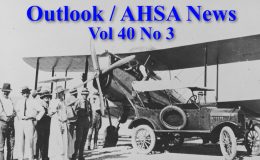
Cover splash image for Outlook AHSA Newsletter Vol 40 No 3
DerekB30/12/202431/12/2024

Outlook AHSA Newsletter December 2024

The December 2024 edition of Outlook / AHSA News was distributed to members recently. This edition can be read online in the viewer below....

Welcome to the website of the Aviation Historical Society of Australia Inc.
The AHSA is dedicated to recording and promoting Australian aviation history. We find and tell the stories of how aviation (both civil and military) has contributed to the development of Australia and the experiences of Australian people.
To navigate around the site, select from the menu bar above, click on one of the updates below or choose one of the categories below.

On this day in Australian aviation history:

1929 After a forced landing west of Wyndham, WA, Charles Kingsford Smith, Charles Ulm, Harold Litchfield and Tom McWilliams were stranded for a sixth day on 5 April 1929. Ulm recorded the following in his log: "Have decided to cross the mud claypan and light fires. There is not one capable of climbing the hill again. All slept better last night, but are weaker. A cloudless sky and the heat is terrible. Mac found some mud snails in the mangrove swamps which we ate. Ugh, awful! But we feel stronger. Smithy and I are going to have a shot at cutting down a tree. Our tools were two screw drivers and rocks for hammers. Had to give it up, as it was too strenuous in our weakened condition. When we return to the shade of the wings we all just collapsed. Oh! curse these flies." The Western Australian Airways DH.50 piloted by James Woods again flew over the Drysdale River mission and ascertained that the Southern Cross had passed over the mission at 11am on 30 March, and that the crew had dropped a message - this was the first time that these points had been established. In the other WAA DH.50 Eric Chater flew from Broome to the Avon Valley cattle station, with no sighting or news of the Southern Cross. The DH.61 "Canberra" flown by Les Holden departed from Richmond on 5 April and flew to Menindee, stopping at Parkes to refuel. Wing-Commander Lawrence Wackett completed preparations for the departure of the RAAF Wackett Widgeon II amphibian and took off from Richmond on the morning of 5 April. However the aircraft could not climb above 1,000 feet and Wackett returned to Richmond, abandoning the attempt. The Minister for Defence, Sir William Glasgow, said that if necessary, he was prepared to send additional aeroplanes from Melbourne to assist with the search. He instructed that two RAAF aircraft would be fuelled and made ready for immediate departure (a DH.50 and a DH.9A). A third departure from Richmond on 5 April was Keith Anderson and Henry Smith "Bob" Hitchcock, flying Keith's Westland Widgeon monoplane G-AUCA, whose flight had been funded by John Cantor, owner of the Sydney Customs House hotel. Anderson and Hitchcock flew to Broken Hill where they made an overnight stop. Before making Broken Hill Anderson made a landing near Blayney, NSW to ask for directions after getting lost. Anderson had long been a close friend of Kingsford Smith, as they had flown together as pilots at Western Australian Airways in the early 1920s, dreamed up a plan for flying across the Pacific Ocean, and formed a small airline together (Interstate Flying Services). A third DH.50 from Western Australian Airways, piloted by Lieutenant Bertram Heath (RFC, retired) departed from Maylands airport at at daybreak on 5 April and flew to Carnarvon, arriving at 11:55am. This aircraft was chartered by Western Australian Newspapers Limited, and had two journalists aboard, representing The West Australian and The Western Mail. From Carnarvon they flew to Roeburn where they stopped overnight. This aircraft was fitted with an auxiliary tank in the cabin which allowed the main fuel tank in the upper wing to be refilled in flight. A seventh aircraft set out to join the search on 5 April, a Gipsy Moth flown by Captain Matheson who departed from Golburn accompanied by Ernest Finn as his mechanic. The aircraft was owned by the Golburn Aero Club, and was funded by the people of Golburn. However Matheson and Finn made a forced landing at Gunning, NSW due to problems with their carburettor. They resumed their flight but were forced to land again and wait for a replacement carburettor to be sent. The forced landing by the Southern Cross and its consequences became known as the "Coffee Royal" affair. Sources: Parnell, N. and Boughton, T., Flypast, A Record of Aviation in Australia, Australian Government Publishing Service, Canberra, 1988; Morning Bulletin (Rockhampton, Qld), Mon 15 Apr 1929, Page 9, "LIEUTENANT ULM'S LOG"
1943 North American B-25D Mitchell N5-140 operated by the ML-KNIL (Royal Netherlands East Indies Army Air Force) crashed into Beagle Gulf, 1 mile of Nightcliff, NT on 05 April 1943. The aircraft departed Darwin in the morning for an attack on Timor, but crashed shortly after take-off, killing all five crew members. Source: aviation-safety.net
2001 The Senate Rural and Regional Affairs and Transport Legislation Committee concluded an extended inquiry into the impact of airspace management, ASA services, and aspects of air safety on 5 April 2001. The report noted the criticisms of the Airspace 2000 model, location specific pricing of terminal navigation and firefighting services as leading to increasing costs for regional aviation. The report generally called for more study into these matters. The Inquiry later continued on to CASA's Administration of Air Operator Maintenance, Regulation and Oversight functions as well as CASA's oversight and auditing of Ansett's maintenance regimes. A leaked internal audit report suggested that CASA had not improved since the 1999 Auditor General's report. The Opposition called for the next Australian National Audit Office review of CASA to be brought forward. Source: Airspace 2000 and Related Issues; Australian Aviation 6/01. via aph.gov.au website

A Mouse At Moresby Ansett Airways Ansett Flying Boat Services Ballarat Bellanca 28/70 Bill Bedford Boeing Brinsmead Bronco CAC CAC Boomerang CAC Ceres CAC Mustang CAC Wackett Trainer CAC Wirraway CAC Woomera Chartair Cyclone Tracy DAP DC-3 DCA DH.50 DH60 Moth Double Sunrise Duigan Memorial Lecture Eric Bonar Essington Lewis Eyre Peninsula Airways GAF Guinea Airways Halestorm JC Fitzmaurice Junkers F13 Lawrence Wackett Macchi Meteor Michael Smith Outlook Percival Proctor Qantas RAF 205 Squadron RFD Winged Target Roy Goon Sid Marshall Target towing

Site Categories:

  • AHSA Info
  • AHSA Journal
  • AHSA Meetings
  • AHSA Videos
  • Archives
  • Aviation history books
  • CAC
  • Events
  • Newsletter

Privacy Policy

Contact Us

Home

Copyright © 2025 Aviation Historical Society of Australia Inc.