Skip to content
  • Home
  • AHSA
    • AHSA Inc. Meetings
    • AHSA Inc
      • AGM 2022
    • AHSA (NSW) Inc.
    • AHSA (QLD) Inc.
    • Privacy Policy
    • Disclaimer
  • Publications
    • Aviation Heritage
    • Aviation Heritage Web Archive
    • AHSA Newsletter Archive
  • Members
    • Members Only
  • Books
  • Join
  • Links
  • Store
  • Log In
    • My Membership Account
Aviation Historical Society of Australia
  • Home
  • AHSA
    • AHSA Inc. Meetings
    • AHSA Inc
      • AGM 2022
    • AHSA (NSW) Inc.
    • AHSA (QLD) Inc.
    • Privacy Policy
    • Disclaimer
  • Publications
    • Aviation Heritage
    • Aviation Heritage Web Archive
    • AHSA Newsletter Archive
  • Members
    • Members Only
  • Books
  • Join
  • Links
  • Store
  • Log In
    • My Membership Account

Tag: Percival Proctor

DerekB06/03/202303/06/2023

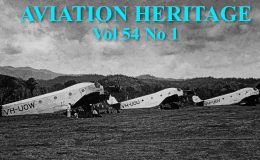
Aviation Heritage Vol. 54 No. 1 (March 2023) Contents Listing

The latest quarterly edition (March 2023) of the AHSA journal – Aviation Heritage – has recently been posted to members. The full contents are...

Welcome to the website of the Aviation Historical Society of Australia Inc.
The AHSA is dedicated to recording and promoting Australian aviation history. We find and tell the stories of how aviation (both civil and military) has contributed to the development of Australia and the experiences of Australian people.
To navigate around the site, select from the menu bar above, click on one of the updates below or choose one of the categories below.

On this day in Australian aviation history:

1929 After being located beside the Glenelg River by search aircraft, Charles Kingsford Smith, Charles Ulm, Harold Litchfield and Tom McWilliams had their first contact with rescuers on 13 April 1929. Ulm recorded the following in his log: "All buds greet the day with rejoicing, knowing that we will again make contact with the rest of our fellows. Sure enough the Canberra arrived shortly before 1 o'clock, and Bertie Heath's 'plane, with a "West Australian" newspaper man on board. Loud cheers! More grub! We can stay in the Coffee Royal for a month. It's not a bad old place after all!" Les Holden again flew the DH.61 "Canberra" from Wyndham to the location of the Southern Cross, and observed the Southern Cross crew from the air, dropping more food and supplies. Captain Clive Chateau described the day's events: "The Canberra took off this morning at 10.50 to drop further provisions. Sheets, blankets, canvas hats, shirts, trousers, candles, fresh vegetables, tinned fruits, citronella, fly veils, meats, cheese, butter, bread knives a spoon, pipes, tobacco, cigarette papers, matches, a wireless aerial wire, butter, herrings, sardines, tinned prunes, lime juice, medicine, and enough to set up a general store. Fishing lines, hooks, billy cans, pannicans were also dropped. Heath also started off from Derby with almost a duplicate parcel of supplies. Smithy and his party will be rather embarrassed with all these things which they have received. If they are picked up within a few days it is estimated that they will require a string of donkeys to salvage their stores. It is the begining of the end of a very fine effort to rescue." The following wireless messages were received from Les Holden in the Canberra: 1.10: I desire to thank all those at Wyndham for their assistance during the search. 1.20: On the second trip to Southern Cross. Again taking provisions - In fact, we have more than a dozen parcels to drop, consisting of things that are generally stocked by a country store. For instance, we have for them tea, sugar and salt, &c tinned meats, mosquito nets, citronella, tobacco, cigarettes, shirts and trousers, fishing lines, revolver and bullets, &c., & c., also some green vegetables and fruit. Dropping 85 telegrams received last night. 1.50: We are now on our way to the Southern Cross. 1.55: We have Just picked up Mt. Trafalgar and Mt. Waterloo about 50 miles away on our immediate front. 2.23: We will cross Prince Regent River in 10 minutes. Should be over Southern Cross in 25 minutes. 2.35: Have now sighted Glenelg River and George's Water. Over Southern Cross in 10 minutes. 2.45: Will be busy now for about half-hour (operator at Darwin adds that he presumes the wireless operator on Canberra will be too busy dropping parcels in that period to bother about sending wireless messages). 3.30: We are now on S.W. course to Derby. Kingsford-Smith and crew of Southern Cross now appear well on way to be rescued, for while Canberra was dropping provisions, W.A. 'plane flew lup and landed on mud flat near Southern Cross." After seeing that all was well, the Canberra continued on to Derby. Bert Heath in the Western Australian Airways DH.50 sponsored by West Australian newspapers landed beside the Southern Cross and had the first contact with the stranded crew. The presence of a journalist from The West Australian caused a little awkwardness since the Southern Cross had been sponsored by a rival newspaper (The Sun/Herald) which expected to receive all the news first, but an arrangement was agreed and photos were taken and stories and logs were provided. The WAA DH.50 piloted by James Woods did not fly on 13 April as its engine was being overhauled. The seaplane carrier HMAS Albatross returned to Sydney on 13 April after departing the day before to join the search. Keith Anderson and Bob Hitchcock and the Kookaburra were stranded in the Tanami desert for a third day on 13 April. Their meagre supply of food and water was exhausted and they were unable to make any further attempts to take off. The two RAAF de Havilland DH.9A aircraft (A1-1 flown by FLTLT Charles Eaton with CPL P. Sullivan as mechanic and A1-7 flown by FLGOFF A.G. Gerrand with SGT J.A. Campbell as mechanic) arrived at Marree, SA for an overnight stop. The forced landing by the Southern Cross and its consequences became known as the "Coffee Royal" affair. Sources: Parnell, N. and Boughton, T., Flypast, A Record of Aviation in Australia, Australian Government Publishing Service, Canberra, 1988; Morning Bulletin (Rockhampton, Qld), Mon 15 Apr 1929, Page 9, "LIEUTENANT ULM'S LOG"; Davis, Pedr and Smith, Dick, Kookaburra: The Most Compelling Story in Australia's Aviation History, Lansdowne Press, Dee Why, NSW, 1980
1943 PBY-5 Catalina A24-36 of 11 Squadron RAAF crashed into Cairns harbour on 13 April 1943 after returning from a night-time search patrol. The aircraft had flown for 23 hours 23 minutes and ran out fuel. Six of the eight crew members were killed. The aircraft was damaged beyond repair. Source: Australia @ War website

A Mouse At Moresby Ansett Airways Ansett Flying Boat Services Ballarat Bellanca 28/70 Bill Bedford Boeing Brinsmead Bronco CAC CAC Boomerang CAC Ceres CAC Mustang CAC Wackett Trainer CAC Wirraway CAC Woomera Chartair Cyclone Tracy DAP DC-3 DCA DH.50 DH60 Moth Double Sunrise Duigan Memorial Lecture Eric Bonar Essington Lewis Eyre Peninsula Airways GAF Guinea Airways Halestorm JC Fitzmaurice Junkers F13 Lawrence Wackett Macchi Meteor Michael Smith Outlook Percival Proctor Qantas RAF 205 Squadron RFD Winged Target Roy Goon Sid Marshall Target towing

Site Categories:

  • AHSA Info
  • AHSA Journal
  • AHSA Meetings
  • AHSA Videos
  • Archives
  • Aviation history books
  • CAC
  • Events
  • Newsletter

Privacy Policy

Contact Us

Home

Copyright © 2025 Aviation Historical Society of Australia Inc.