Skip to content
  • Home
  • AHSA
    • AHSA Inc. Meetings
    • AHSA Inc
      • AGM 2022
    • AHSA (NSW) Inc.
    • AHSA (QLD) Inc.
    • Privacy Policy
    • Disclaimer
  • Publications
    • Aviation Heritage
    • Aviation Heritage Web Archive
    • AHSA Newsletter Archive
  • Members
    • Members Only
  • Books
  • Join
  • Links
  • Store
  • Log In
    • My Membership Account
Aviation Historical Society of Australia
  • Home
  • AHSA
    • AHSA Inc. Meetings
    • AHSA Inc
      • AGM 2022
    • AHSA (NSW) Inc.
    • AHSA (QLD) Inc.
    • Privacy Policy
    • Disclaimer
  • Publications
    • Aviation Heritage
    • Aviation Heritage Web Archive
    • AHSA Newsletter Archive
  • Members
    • Members Only
  • Books
  • Join
  • Links
  • Store
  • Log In
    • My Membership Account

Tag: RFD Winged Target

DerekB06/03/202303/06/2023

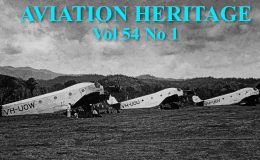
Aviation Heritage Vol. 54 No. 1 (March 2023) Contents Listing

The latest quarterly edition (March 2023) of the AHSA journal – Aviation Heritage – has recently been posted to members. The full contents are...

Welcome to the website of the Aviation Historical Society of Australia Inc.
The AHSA is dedicated to recording and promoting Australian aviation history. We find and tell the stories of how aviation (both civil and military) has contributed to the development of Australia and the experiences of Australian people.
To navigate around the site, select from the menu bar above, click on one of the updates below or choose one of the categories below.

On this day in Australian aviation history:

1941 CAC CA-5 Wirraway A20-132 of 12 Squadron RAAF crashed at Adelaide River Railway Station, Northern Territory on 15 March 1941. 0118 hrs. Pilot F/O Francis Burton Smith 645 and crew Sgt Walter James Cox 2403 were both were killed. The RAAF Preliminary Report listed the cause as "obscure". Sources: NAA: A9845, 106; aviation-safety.net website
1943 RAAF Spitfire VC, A58-92 (BS231) piloted by SQNLDR Thorold-Smith, the Commanding Officer of 452 Squadron, departed RAAF Darwin with four other Spitfires at 10:30 hours to return to Strauss after practice night flying. On becoming airborne, the section received a "Scramble" order, and SQNLDR Thorold-Smith was told to lead the Wing. They rendezvoused with 54 Squadron aircraft and climbed steadily. At approximately 17,000 feet two aircraft from S/Ldr Thorold-Smith's section had dropped out due to lack of oxygen. When at 20,000 feet the section sighted a large formation of enemy aircraft at approximately 21,000 feet, 7 to 10 miles North West of themselves and flying towards Darwin for a bombing raid. The section climbed alongside the enemy formation which consisted of 20 bombers and a close escort of 22 fighters. By that time the Wing comprised 19 aircraft some of whom were straggling behind. When about 500 feet above the bombers SQNLDR Thorold-Smith gave the order to attack the bombers, the section made for the bombers, but were intercepted by the enemy fighters. About thirty seconds after the initial attack, FLTLT Ball witnessed a Spitfire, turning from west to north and smoking in a slight dive, approximately over Point Charles. FLGOFF Goldsmith also reported seeing a Spitfire smoking in a vertical dive. Searches in the area that afternoon returned no results. Aircraft from 452 Squadron were sent out that afternoon to search the Point Charles area out to sea North West of Point Charles for any signs of the crashed Spitfire, a parachute or a dinghy. Nothing was found. A 452 Squadron aircraft was later sent up to search, but nothing was seen. SQNLDR Raymond Edward Thorold-Smith, DFC is still listed as missing. Source: Ozatwar website
1947 Lincoln A73-2 "Nyhuan" (Pathfinder) from No 1 Aircraft Performance Unit at Point Cook, Victoria, conducted a pioneering flight from mainland Australia to the edge of the Antarctic zone on 15 March 1947. The aircraft, which was fitted with advanced navigation equipment, collected meteorological data and photographed Macquarie Island which lies 1466 kilometres south of Tasmania. The aircraft was airborne for 14 hours 35 minutes and completed the flight in deteriorating weather. This effort was seen as an essential precursor to the scientific voyages launched by the Australian National Antarctic Research Expedition (ANARE) from December 1947. Source: Royal Australian Air Force
1974 Aero Commander 100 VH-BFA owned by The Pilot Makers E.F.T.S. Pty. Ltd. crashed at Moorooduc, near Melbourne, Victoria on 15 March 1974. The pilot had commenced flying training with Pilot Makers on 2 February, 1974 and all of his training had been carried out in Auster type aircraft. His first and only solo flight was made on 11 March. He had also flown as a passenger in VH-BFA on two occasions. A further training flight had been arranged for 1030 hours on the day of the accident but, prior to this time, the pilot cancelled the arrangement by telephone. Nevertheless, at about 1100 hours he arrived at the flight office of the operator at Moorooduc and, some time later, he was observed walking towards the line of parked aircraft. At about 1200 hours the instructor in charge, who was then in the flight office some 1500 metres from the parked aircraft, heard an aircraft engine start and he established that the aircraft concerned was VH-BFA. As he had not authorised any person to fly VH-BFA, the instructor drove his car to intercept the aircraft which had by then commenced taxying towards the airstrip. The car arrived at the southern end of the airstrip as the aircraft commenced to take off towards the north. After a short ground roll, the aircraft became airborne and climbed steeply to a height of about 150 feet. It then commenced a steep climbing turn to the left and, after turning through some 90 degrees, the nose dropped and the aircraft dived to the ground and overturned after impact. Shortly after impact a fierce fire broke out and extended to the surrounding scrub. It was subsequently established that the pilot was suffering from a mental illness for which he had been receiving treatment since 1972. On 4 February 1974 he was medically examined in connection with his application for a student pilot licence. He did not disclose his mental illness to the medical examiner. Sources: ATSB; aviation-safety.net website
1978 Piper PA-32-300 VH-SES crashed 2.5km SSW of Warrnambool, Victoria on 15 March 1978. After departing from Moorabbin, the pilot was advised by Melbourne Flight Service Unit that reports had been received of deteriorating weather in the Warrnambool area and he acknowledged this information. At 1845 hours the pilot made a general radio broadcast that he was 'one zero miles east, inbound' and he then reported that he was 'leaving four thousand on descent into Warrnambool.' At 1850 hours, following a query from Melbourne FSU as to whether he had arrived at Warrnambool, the pilot advised 'circuit area Warrnambool this time - I'll be holding in the area for up to one zero minutes due to cloud - there's a break out to the west - if it doesn't uncover I'll go up to Hamilton'. When asked to confirm that he was in VMC at that time, the pilot replied 'affirmative'. No further communications were received from the aircraft. Shortly before the accident, the sound of an aircraft engine was heard over the Warrnambool aerodrome and the aircraft was apparently heading to the south. Some two minutes later, the engine noise was heard approaching the aerodrome from the south-west. The noise decreased and increased several times before it increased dramatically to a high pitch. An impact noise was then heard and the engine noise ceased. The aircraft struck the ground in an open field at high speed in a steep nose down attitude. There was no fire. Detailed examination of the wreckage did not reveal evidence of any defect or malfunction which might have contributed to the accident. The probable cause of the accident was that the pilot persisted with an approach for landing in adverse weather conditions during which he lost control of the aircraft for reasons which could not be determined. There were 2 fatalities and the aircraft was written off. Sources: ATSB; aviation-safety.net website
1981 Cessna A150M VH-USD crashed at South Point, Bribie Island, Queensland on 15 March 1981. On the evening before the crash, the pilot attended a social function at which he learnt that two friends intended to go sailing on the following day, in the vicinity of Bribie Island. On the day of the crash, the pilot hired VH-USD for a period of local flying. His private pilot licence was endorsed with an area restriction which, as he had not completed navigation training, limited his flying to within 8 km of the aerodrome, or the local designated training area or the direct route between the aerodrome and training area. The designated training area for Redcliffe Aerodrome included the airspace above Pumicestone Channel, to the west of Bribie Island. At about 1215hours, VH-USD was observed to be operating at low level over the Pumicestone Channel, between the Bribie Island Bridge and South Point. Its height was estimated to be 100 to 200 feet above sea level. It passed over the boat containing the pilot's friends. It was being flown at a low speed, with the wings being 'waggled' and the exterior lights being flashed. After the final pass, from north to south, the aircraft nose was raised to a high attitude and engine power was heard to increase. The engine noise then suddenly reduced and the mose of the aircraft yawed rapidly to the right, consistent with the initiation of a stall-turn manoeuvre. However, the aircraft then entered a spin which continued until it struck the water, approximately 800 metres west of South Point. There were 2 fatalities and the aircraft was written off. The probable cause of the accident was that the pilot attempted to carry out aerobatic manoeuvres at an unsafe altitude. Sources: ATSB; aviation-safety.net website
1997 Busselton Margaret River Airport opened on 15 March 1997, as the gateway to Busselton, the Margaret River Region and Western Australia’s South West. Busselton Margaret River Airport is owned and operated by the City of Busselton. Source: Busselton Margaret River Airport
2005 Queensland Airports Limited acquired 100% ownership of both Townsville Airport Pty Limited and Mount Isa Airport Pty Limited on 15 March 2005. Source: Queensland Airports Limited
2016 Air New Zealand and Virgin Australia announced a partnership to investigate options for locally produced aviation biofuel on 15 March 2016. The trans-Tasman alliance partners are issuing a Request for Information (RFI) to the market to explore the opportunity to procure locally-produced aviation biofuel. Air New Zealand Chief Flight Operations and Safety Officer Captain David Morgan says the airline recognises the impact aviation has on the environment and this RFI is a key initiative under its carbon management programme. “By working in partnership with our alliance partner Virgin Australia we hope we can stimulate the local market, drive innovation and investment and potentially uncover a sustainable biofuel supply suitable for our respective operations,” says Captain Morgan. Virgin Australia Head of Sustainability Robert Wood says the airline is committed to stimulating the development of a sustainable aviation biofuel industry in the region. “Aviation biofuel offers a significant opportunity for the aviation industry to reduce emissions whilst also building long-term fuel security for the sector,” says Mr Wood. Interested parties had until 30 May 2016 to express their interest. Source: Virgin Australia newsroom

A Mouse At Moresby Ansett Airways Ansett Flying Boat Services Ballarat Bellanca 28/70 Bill Bedford Boeing Brinsmead Bronco CAC CAC Boomerang CAC Ceres CAC Mustang CAC Wackett Trainer CAC Wirraway CAC Woomera Chartair Cyclone Tracy DAP DC-3 DCA DH.50 DH60 Moth Double Sunrise Duigan Memorial Lecture Eric Bonar Essington Lewis Eyre Peninsula Airways GAF Guinea Airways Halestorm JC Fitzmaurice Junkers F13 Lawrence Wackett Macchi Meteor Michael Smith Outlook Percival Proctor Qantas RAF 205 Squadron RFD Winged Target Roy Goon Sid Marshall Target towing

Site Categories:

  • AHSA Info
  • AHSA Journal
  • AHSA Meetings
  • AHSA Videos
  • Archives
  • Aviation history books
  • CAC
  • Events
  • Newsletter

Privacy Policy

Contact Us

Home

Copyright © 2025 Aviation Historical Society of Australia Inc.