Skip to content
  • Home
  • AHSA
    • AHSA Inc. Meetings
    • AHSA Inc
      • AGM 2022
    • AHSA (NSW) Inc.
    • AHSA (QLD) Inc.
    • Privacy Policy
    • Disclaimer
  • Publications
    • Aviation Heritage
    • Aviation Heritage Web Archive
    • AHSA Newsletter Archive
  • Members
    • Members Only
  • Books
  • Join
  • Links
  • Store
  • Log In
    • My Membership Account
Aviation Historical Society of Australia
  • Home
  • AHSA
    • AHSA Inc. Meetings
    • AHSA Inc
      • AGM 2022
    • AHSA (NSW) Inc.
    • AHSA (QLD) Inc.
    • Privacy Policy
    • Disclaimer
  • Publications
    • Aviation Heritage
    • Aviation Heritage Web Archive
    • AHSA Newsletter Archive
  • Members
    • Members Only
  • Books
  • Join
  • Links
  • Store
  • Log In
    • My Membership Account

Tag: Eric Bonar

DerekB06/03/202303/06/2023

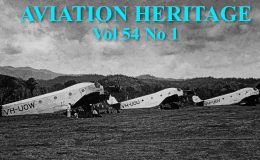
Aviation Heritage Vol. 54 No. 1 (March 2023) Contents Listing

The latest quarterly edition (March 2023) of the AHSA journal – Aviation Heritage – has recently been posted to members. The full contents are...

Welcome to the website of the Aviation Historical Society of Australia Inc.
The AHSA is dedicated to recording and promoting Australian aviation history. We find and tell the stories of how aviation (both civil and military) has contributed to the development of Australia and the experiences of Australian people.
To navigate around the site, select from the menu bar above, click on one of the updates below or choose one of the categories below.

On this day in Australian aviation history:

1929 After a forced landing west of Wyndham, WA, Charles Kingsford Smith, Charles Ulm, Harold Litchfield and Tom McWilliams were still stranded beside the Glenelg River on 12 April 1929. Ulm recorded the following in his log: "Smithy and Litchfield stayed last night on Darlinghurst Hill. Mac and I could not sleep down here. We are on the last of the gruel now and taking almost pure hot water. Mac is wearing shorts only and is as brown as a berry. I started yesterday, but am rather scared of severe sunburn. SAVED! SAVED! 9.50. We are saved! Saved! Holden's Canberra appears from the south-east, making a long wide turn to the cast, continuing in another from east to south to west. Eventually at 10 a.m. it came low down over the Southern Cross, and circled for well over an hour, dropping four packs of rations. God, its all too wonderful! Food! Smithy and Litchfield rushed down from Darlinghurst Hill with tears in their eyes and whoops of joy. We are all in. But see! Oh see! the old Southern Cross is in one piece and eventually we will fly out. We just tore open two tins of bully beef and ate it like animals. Holden has returned to Wyndham, first dropping a message saying he would return with more food and messages. God bless him! God bless everybody! Litchfield and Mac are great lads. We had previously decided that if rescued Smithy and I would stay and fly the 'bus out, sending Litchfield and Mac out by the rescue 'planes. But no! Now they absolutely mutiny and refuse to leave any time without us, so we have agreed to their mutinous request and all will leave together in the good old Southern Cross. How we ate that first food for twelve days - meat, raisins, cafe chocolate - everything in together, really like animals, and unclean ones at that." Les Holden flying the DH.61 "Canberra" had left Derby just before 8:00am carrying Hamilton, J.S. Stannage (radio operator), F.R. Mitchell (mechanic), Lyell Dunn and Douglas Davidson. The radio messages sent from the aircraft were as follows: "9.18 am - We have just sighted Mount Trafalgar and Mount Waterloo to the north of St. George's Basin. Still about 50 miles away. 9.22 am - We are now crossing over Princess Mary Ranges; should be at Prince Regent River shortly. 9.37 am - In five minutes we will cross the Prince Regent River at the point where it runs into St. George's Basin. We are on our way to Port George IV mission to see if they can give any more definite information. 9.45 am - After visiting Port George IV we will search all the bays and inlets as far as Cape Londonderry. 11.31 am - Found Southern Cross: all O.K., all alive; have dropped food. News later. 11.35 am - Canberra confirms finding Southern Cross crew all alive. 11.37 am - We are climbing higher to get better view so we can more directly pin-point the position of the Southern Cross. 11.38 am - They must be eating now; have not seen them for few minutes. Dropping more food. 11.40 am - Can now see whole crew. All Safe. 11.47 am - Found alive. All well. Position south of Port George IV mission on mud flats. 11.58 am - Can see whole crew now. All safe. 12.03 pm - Have now pin-pointed Southern Cross's position, which is approximately Glenelg River about 20 miles from George Waters. 12.09 pm - Still flying round Southern Cross, 12.10 pm - Advise Smith, Ulm, Litchfield and McWilliams's families that the airmen are well and have plenty of water as they have good creek running near them. 12.15 pm - We have now left the Southern Cross and are about to pass over St. George's Basin, near Patrick Island." The Canberra arrived back at Wyndham at 3.53 pm, after being in the air for over six hours. The evening papers in the capital cities reported the news with front-page headlines. The Sun (Sydney) which had sponsored the flight to London devoted the entire front page to the news, with pictures of all four aviators. After resuming their flight towards Wyndham to join the search, Captain Matheson and Finn in the Golburn Aero Club Gipsy Moth were again forced to land due to engine trouble, in "heavily timbered country" near Duchess, 50 miles southwest of Cloncurry. A piston ring had burned through, and they waited a week for spare parts to arrive. On 19 April, the Defence Department sent a telegram to Golburn Aero Club asking that Matheson not to proceed any further. Newspapers gave differing reasons, either "as his machine would be too slow to operate with the others in the search [for Anderson and Hitchcock]" or "in view of the unsuitability of the Gipsy Moth machine, and the danger of operating west of the telegraph line without wireless equipment". Keith Anderson and Bob Hitchcock and the Kookaburra were stranded in the Tanami desert for a second day on 12 April. Two RAAF de Havilland DH.9A aircraft left Point Cook to fly northwest and commence a search. One was flown by FLTLT Charles Eaton and the other by FLGOFF A.G. Gerrard, and each carried a mechanic. The forced landing by the Southern Cross and its consequences became known as the "Coffee Royal" affair. Sources: Parnell, N. and Boughton, T., Flypast, A Record of Aviation in Australia, Australian Government Publishing Service, Canberra, 1988; Morning Bulletin (Rockhampton, Qld), Mon 15 Apr 1929, Page 9, "LIEUTENANT ULM'S LOG"; Davis, Pedr and Smith, Dick, Kookaburra: The Most Compelling Story in Australia's Aviation History, Lansdowne Press, Dee Why, NSW, 1980
1947 The Bristol Freighter demonstrator G-AIMC "Merchant Venturer" made an emergency landing at Darwin airport on Saturday 12 April 1947 after elevator control was lost on its first Australian demonstration flight. The aircraft arrived from England two days before. According to a newspaper report the aircraft took of at about 10:00 am and had been airborne for only a few minutes when a hatch which had not been properly secured blew off and struck the port horizontal stabiliser "with tremendous force neutralising the effect of the elevators". The noise made by the hatch striking the tailplane startled the passengers, and the forward motion of the plane became unsteady. Captain R. Ellison, who was at the controls, turned back to the aerodrome and prepared to land immediately, but when he attempted to put the nose down, the plane dropped violently. This happened twice, but control was maintained by the captain. Luggage flew out of the overhead racks as the plane dropped and the passengers fastened their safety belts, but a few minutes later the captain put the plane down in a perfect landing. RAAF pilots who saw the damage said that Captain Ellison must have done a marvellous job to put a plane of such size down without elevator control. Passengers on the plane at the time included the Administrator (Mr. A.R. Driver), the GO of the Seventh Military District (Brigadier I. Fullarton), the NOIC Darwin (Comander G. Gower), the AOC NW Area (Group Captain E.G. Fyfe, DSO) and Mrs. Fyfe, the Officer in Charge of Civil Aviation (Mr F. H. Anderson), The Cheif Medical Officer (Dr. J. G McGlashan), the Melbourne "Herald" correspondent (Mr D. W. Lockwood), Sydney Morning "Herald" correspondent (Mr. M. Ward), the planning and development manager of Australian National Airways (Mr. I.H. Grabawski), the Airways Division manager of Overseas Corporation (Aust.) Ltd (agents for the plane) (Mr. G.C. Nicoll), and a number of RAAF and Qantas personnel. The company chartered a special plane to fly spare parts out from England. The NT and Kimberleys part of the itinerary was cancelled and the demonstrator flew on to Melbourne. Source: Northern Standard (Darwin, NT), Fri 18 Apr 1947, Page 9, "Bristol Freighter In Mishap On First Demonstration"
1962 At 1018 hours Eastern Standard Time on 12 April 1962, a British registered Mustang aircraft departed Moorabbin Aerodrome, Victoria, for Bankstown Aerodrome, New South Wales. The only occupant of the aircraft was the pilot, Ron Flockhart, whose intention it was to fly to Bankstown for the purpose of having some items of radio and navigation equipment serviced. Six minutes after departure Flockhart advised Air Traffic Control that he was returning to Moorabbin because he was unable to proceed in conformity with the visual flight rules. Three minutes later again, he advised that he was having trouble and was flying in cloud at 3,000 feet. Air Traffic Control requested the pilot to maintain 3,000 feet and to home on the Moorabbin N.D.B. but soon after this request, the aircraft was seen to emerge from low cloud in the vicinity of Kallista and strike trees and the ground in a steep dive. The aircraft was destroyed by impact forces and the pilot was killed. Mr. Flockhart proposed to fly the aircraft from Australia to England in an attempt to better the existing record flying time for a solo flight between the two countries. On the day of the accident he arranged to fly the aircraft from Moorabbin to Bankstown where some items of radio and navigational equipment were to undergo maintenance in preparation for the record attempt. Source: ATSB, Aviation Safety Digest June 1963
2001 Just prior to Easter on 12 April 2001, CASA grounded ten of Ansett's Boeing 767 aircraft after one was found to be flying with an inoperable emergency slide. The continuing problems were said to reflect a lack of control and alleged deficiencies in CASA's surveillance perhaps due to cost cutting and staff cutbacks. CASA threatened Ansett with withdrawal of its Air Operators Certificate by 20 April 2001. See also ATSB Occurrence Detail #200101606. Source: Canberra Times, 17 and 22 April 2001. Aviation Week and Space Technology,23 April 2001. Australian Financial Review, 18 April 2001. Australian Aviation, 6/01. via aph.gov.au website

A Mouse At Moresby Ansett Airways Ansett Flying Boat Services Ballarat Bellanca 28/70 Bill Bedford Boeing Brinsmead Bronco CAC CAC Boomerang CAC Ceres CAC Mustang CAC Wackett Trainer CAC Wirraway CAC Woomera Chartair Cyclone Tracy DAP DC-3 DCA DH.50 DH60 Moth Double Sunrise Duigan Memorial Lecture Eric Bonar Essington Lewis Eyre Peninsula Airways GAF Guinea Airways Halestorm JC Fitzmaurice Junkers F13 Lawrence Wackett Macchi Meteor Michael Smith Outlook Percival Proctor Qantas RAF 205 Squadron RFD Winged Target Roy Goon Sid Marshall Target towing

Site Categories:

  • AHSA Info
  • AHSA Journal
  • AHSA Meetings
  • AHSA Videos
  • Archives
  • Aviation history books
  • CAC
  • Events
  • Newsletter

Privacy Policy

Contact Us

Home

Copyright © 2025 Aviation Historical Society of Australia Inc.