Skip to content
  • Home
  • AHSA
    • AHSA Inc. Meetings
    • AHSA Inc
      • AGM 2022
    • AHSA (NSW) Inc.
    • AHSA (QLD) Inc.
    • Privacy Policy
    • Disclaimer
  • Publications
    • Aviation Heritage
    • Aviation Heritage Web Archive
    • AHSA Newsletter Archive
  • Members
    • Members Only
  • Books
  • Join
  • Links
  • Store
  • Log In
    • My Membership Account
Aviation Historical Society of Australia
  • Home
  • AHSA
    • AHSA Inc. Meetings
    • AHSA Inc
      • AGM 2022
    • AHSA (NSW) Inc.
    • AHSA (QLD) Inc.
    • Privacy Policy
    • Disclaimer
  • Publications
    • Aviation Heritage
    • Aviation Heritage Web Archive
    • AHSA Newsletter Archive
  • Members
    • Members Only
  • Books
  • Join
  • Links
  • Store
  • Log In
    • My Membership Account

Tag: Duigan Memorial Lecture

DerekB26/10/202526/10/2025

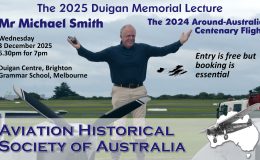
2025 Duigan Memorial Lecture – Michael Smith

The Aviation Historical Society of Australia is pleased to announce the 2025 Duigan Memorial Lecture, to be held at the Duigan Centre, Brighton Grammar...
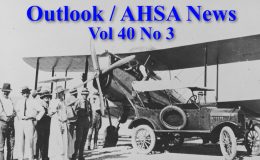
Cover splash image for Outlook AHSA Newsletter Vol 40 No 3
DerekB30/12/202431/12/2024

Outlook AHSA Newsletter December 2024

The December 2024 edition of Outlook / AHSA News was distributed to members recently. This edition can be read online in the viewer below....

Welcome to the website of the Aviation Historical Society of Australia Inc.
The AHSA is dedicated to recording and promoting Australian aviation history. We find and tell the stories of how aviation (both civil and military) has contributed to the development of Australia and the experiences of Australian people.
To navigate around the site, select from the menu bar above, click on one of the updates below or choose one of the categories below.

On this day in Australian aviation history:

1931 On 21 March 1931 the "Southern Cloud" VH-UMF, one of the five Avro Ten aircraft operated by ANA, failed to reach Melbourne on a scheduled service from Sydney. The Southern Cloud departed at 8:10 AM from Sydney carrying six passengers and two crew, including pilot Travis "Shorty" Shortridge. Weather conditions en route were hazardous and much worse than predicted. Despite extensive search efforts, the wreck of the Southern Cloud was not found until 1958 when a bushwalker discovered the crash site on the Toolong Range, near Kiandra, New South Wales. No aviation meteorological service existed at the time, but each morning the Sydney Weather Bureau would prepare a special report for the airline on conditions between the three eastern capitals. However the accuracy of these daily reports was limited – the Bureau received weather observations from throughout New South Wales only once each day, and there was little exchange of information with forecasters in other States. The failure of the Southern Cloud to arrive in Melbourne by early afternoon was not at first cause for alarm – some thought that Shortridge had probably landed to refuel, and decided against continuing the flight that day because of the conditions. But by late afternoon, there was grave disquiet. No official search and rescue organisation then existed, but ANA planned to begin searching early the following morning, and notified the aviation authorities. The news that Southern Cloud was overdue produced an immediate response from the infant aviation industry and, within hours, ANA search aircraft had been joined by private, club, business and service aircraft. But after 18 days of searching, during which more than 20 aircraft had checked every possible area in which Southern Cloud could have forced landed, the Minister for Defence instructed the Air Accidents Committee to conduct an investigation “with particular reference to the weather at the time”. The investigation heard evidence from company executives, meteorologists, pilots, ground engineers and Departmental officers, and the Committee found that extreme weather had contributed to the aircraft’s loss. The crew had probably anticipated moderately bad conditions but had had no warning of the actual weather. The Committee’s recommendations included several for improving aviation meteorological services, and that “two- way wireless... be made compulsory in aircraft engaged in regular scheduled passenger services”. Sources: National Museum of Australia; Flight Safety Australia
1942 The air battle for Port Moresby, conducted by No 75 Squadron RAAF from 21 March to 8 May 1942, stands as one of the more remarkable feats in RAAF history. Immediately after forming at Sydney, and converting to an all-new aircraft type, the P40 E Kittyhawk (originally destined for service with the Netherlands East Indies Airforce), the unit was sent north to mount a desperate defence of Port Moresby. The unit’s new pilots had an average of nine hours flying time on the Kittyhawks and had fired their guns only once. They lost five aircraft and three pilots en rote, with bad weather and a lack of radios presenting as major hazards in the course of their journey north. On 21 March the squadron’s aircraft landed at Seven Mile Airfield, just out of of Port Moresby town. The defenders of Port Moresby had seen only enemy fighter aircraft previosly, so as the first flight of Kittyhawks (which, because of the delays in their arrival, had been derisively nicknamed 'Tomorrowhawks" and "Neverhawks") approached Moresby they were shot at by the defenders rendering two of the precious incomers unserviceable. Within hours of arrival, two pilots were scrambled and successfully intercepted and destroyed an enemy reconnaissance aircraft over the town in full view of the garrison, providing a tremendous filip to the morale of the troops. During the air battle lasting just 44 days, 75 Squadron thwarted Japanese plans to capture this crucial allied base and take control of its strategically vital airfields and harbour facilities. Source: RAAF
1972 On 21 March 1972 CSIRO researchers from the Division of Atmospheric Physics aboard the DCA Fokker F-27 VH-CAT collected air samples over Bass Strait during a regular training flight. These samples were analysed for carbon dioxide content - the very first air samples that officially recorded background carbon dioxide levels in the Australian atmosphere. Sources: CSIRO https://www.publish.csiro.au/HR/acc/HR17014/HR17014_AC.pdf; Five DME https://5dme.net/stories-vh-cat-fokker-f27-csiro-story/
1976 Piper PA-32-260 VH-POR crashed 69km SW of Grafton, NSW on 21 March 1976. The wreckage of the aircraft was located on the north-east slope of a ridge in a remote, densely timbered mountainous area. The accident site was virtually on the planned track of the aircraft and there is evidence to indicate that, at the time of initial impact with trees, the aircraft had been on a south-south-westerly heading in gently descending controlled flight with the wings level and at near normal cruising speed. There were 4 fatalities and the aircraft was destroyed. Source: ATSB
2013 Robinson R44 VH-HWQ operated by Bankstown Helicopters crashed at Panorama House, Bulli Tops, near Wollongong, NSW on 21 March 2013. At about 1207 the helicopter landed at a grassed area adjacent to a function centre at Bulli Tops. Shortly after landing, the helicopter was observed to simultaneously lift off, yaw right through 180° and drift towards nearby trees. The helicopter struck branches of the trees before descending, impacting the ground nose low and rolling onto its right side. A short time after coming to rest a fire started and engulfed the helicopter. The pilot and three passengers were fatally injured. Source: ATSB
2022 The first Australian-made uncrewed combat air vehicle was officially named by Minister for Defence the Hon Peter Dutton MP at a ceremony at RAAF Base Amberley on 21 March 2022. Working under the project title, ‘Loyal Wingman’, the the aircraft’s official service name was announced as “MQ-28A Ghost Bat.”. Minister Dutton said “As air warfare grows more complex and more sophisticated, remotely piloted aircraft and other uncrewed platforms are becoming increasingly vital assets for modern militaries. Our partnership with Boeing has successfully designed, manufactured and flown the first Australian-built military combat aircraft in 50 years. This new capability allows us to introduce more mass into the battlespace. An adversarial aircraft would not only have to contend with our crewed capability, but also numbers of uncrewed aircraft such as the MQ-28A Ghost Bat. The three test flight series have been successful and with a range of 3,700 kilometres, it complements our deterrence objective to hold a potential adversary’s forces and infrastructure at risk from a greater distance.” Since 2017 the Coalition Government has invested more than $150 million dollars to support the joint venture between the Royal Australian Air Force and Boeing Defence Australia to deliver the world-leading air system that will team with existing air combat aircraft and conduct air combat, reconnaissance and surveillance missions. RAAF Head of Air Force Capability, Air Vice-Marshal Robert Denney, said that the new name held special significance to the aircraft: “The selection of the new common name Ghost Bat is a key milestone in our continuing advancement of this critical capability for Air Force, and this unique name aligns well with the intent of the aircraft. Ghost Bat reflects the intended mission and operational capabilities of the aircraft. A ghost bat is an Australian hunter which uses sophisticated multi-spectral sensors to detect, hunt and kill prey both in the air and on the ground. They team together in large numbers to confuse and overwhelm their adversaries and are native to Australia." Source: Department of Defence Ministers press release

A Mouse At Moresby Ansett Airways Ansett Flying Boat Services Ballarat Bellanca 28/70 Bill Bedford Boeing Brinsmead Bronco CAC CAC Boomerang CAC Ceres CAC Mustang CAC Wackett Trainer CAC Wirraway CAC Woomera Chartair Cyclone Tracy DAP DC-3 DCA DH.50 DH60 Moth Double Sunrise Duigan Memorial Lecture Eric Bonar Essington Lewis Eyre Peninsula Airways GAF Guinea Airways Halestorm JC Fitzmaurice Junkers F13 Lawrence Wackett Macchi Meteor Michael Smith Outlook Percival Proctor Qantas RAF 205 Squadron RFD Winged Target Roy Goon Sid Marshall Target towing

Site Categories:

  • AHSA Info
  • AHSA Journal
  • AHSA Meetings
  • AHSA Videos
  • Archives
  • Aviation history books
  • CAC
  • Events
  • Newsletter

Privacy Policy

Contact Us

Home

Copyright © 2025 Aviation Historical Society of Australia Inc.