Skip to content
  • Home
  • AHSA
    • AHSA Inc. Meetings
    • AHSA Inc
      • AGM 2022
    • AHSA (NSW) Inc.
    • AHSA (QLD) Inc.
    • Privacy Policy
    • Disclaimer
  • Publications
    • Aviation Heritage
    • Aviation Heritage Web Archive
    • AHSA Newsletter Archive
  • Members
    • Members Only
  • Books
  • Join
  • Links
  • Store
  • Log In
    • My Membership Account
Aviation Historical Society of Australia
  • Home
  • AHSA
    • AHSA Inc. Meetings
    • AHSA Inc
      • AGM 2022
    • AHSA (NSW) Inc.
    • AHSA (QLD) Inc.
    • Privacy Policy
    • Disclaimer
  • Publications
    • Aviation Heritage
    • Aviation Heritage Web Archive
    • AHSA Newsletter Archive
  • Members
    • Members Only
  • Books
  • Join
  • Links
  • Store
  • Log In
    • My Membership Account

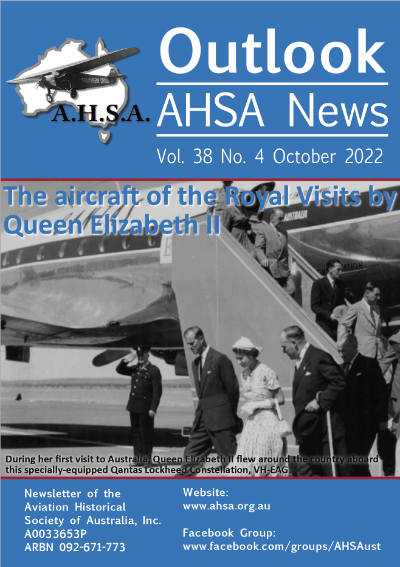
October 2022 Outlook Newsletter

DerekB27/10/202222/11/2022

The October 2022 edition of Outlook / AHSA News has been emailed to members.

This edition can also be read online in the viewer below.

Click here to view fullscreen (opens in a new tab)
Skip to PDF content
  • Twitter
  • Facebook
  • Google+
  • Linkedin
  • Email
Posted inNewsletter

Welcome to the website of the Aviation Historical Society of Australia Inc.
The AHSA is dedicated to recording and promoting Australian aviation history. We find and tell the stories of how aviation (both civil and military) has contributed to the development of Australia and the experiences of Australian people.
To navigate around the site, select from the menu bar above, click on one of the updates below or choose one of the categories below.

On this day in Australian aviation history:

1944 On 6 March 1944, a USAAF C-47A-70-DL Douglas Dakota #42-100723 (#338) was bringing US personnel from New Guinea to Sydney, Australia for rest and recouperation. Many of the men were reported to have been fighter pilots. The aircraft lost a propeller blade over Cessnock in New South Wales and this damaged the right wing of the aircraft. The pilot ordered 15 of the passengers to bail out and 13 of these men survived. Five people remained aboard the aircraft, which made a crash landing in a field near the small township of Laguna south west of Newcastle. A newspaper report quoted the senior officer as being Captain McGuinness. The C-47 was attached to 70th Troop Carrier Squadron, of the 433rd Transport Carrier Group of the 54th Transport Carrier Wing and was crewed by USAAF Personnel. Source: Cessnock Eagle and South Maitland Recorder, Friday 10 March 1944, page 3 via Ozatwar.com website
1985 The well-known ultralight designer Sander Veenstra tragically lost his life in the crash of his "Rustler" ultralight crashed 5km SSE of Nagambie, Victoria on 6 March 1985. Veenstra had been designing and building ultralight aircraft for a number of years. This particular aircraft had been designed for a nosewheel landing gear system, however after flying the aircraft he decided that he did not like this particular configuration. He decided to modify the aircraft to a tailwheel design, and had spent a considerable time over the preceding weeks on the rebuilding program. After completing the work he was forced to wait for several days for suitable weather conditions in which to carry out the first flight. On the morning of the accident he carried out a pre-flight inspection before taxying to the end of the strip in use. He was observed to exercise the controls prior to commencing the take-off. The aircraft became airborne after a ground run of about 125 metres, and the angle of climb was seen to progressively increase. At a height of about 80 feet above the ground the left wing dropped and the aircraft dived steeply to the ground. An inspection of the wreckage revealed that the ailerons had been incorrectly designed and were operating in the reverse sense. It was considered possible that the pilot may have been momentarily confused when the aileron response was not as expected, and may not have noticed the steepening nose attitude in time to take corrective measures. In this design the pilot sat in a totally exposed position at the front of the aircraft, and had only limited pitch references. The pilot had not flown a totally open cockpit aircraft for some considerable time, and was not wearing goggles. Apart from the aileron problem no other faults were found during the investigation. During his pre-flight checks the pilot had evidently not detected that the ailerons operated in the reverse sense. Sources: ATSB website; aviation-safety.net website
1988 Aviasud "Sirocco" ultralight crashed 2.5km SW of Whittlesea, Victoria on 6 March 1988. There was 1 fatality and the aircraft was written off. According to his log book, the pilot had flown the aircraft on two previous occasions of about 15 minutes duration each. The pilot was briefed by the owner of the aircraft on power settings and speeds. He then took-off into the south from the strip which is aligned approximately north-south. There was a light southerly breeze blowing at the time. The aircraft was seen to make one right-hand circuit, but it could not be determined if the aircraft actually made a landing from that circuit. When the aircraft was on final approach from a second right-hand circuit at an estimated altitude of about 200-300 feet, it entered a turn to the right. As the turn progressed onto a northerly (downwind) heading, the angle of bank became progressively steeper until it was about 90 degrees. The nose then dropped and the aircraft dived to the ground. The investigation did not reveal any pre-existing defects that may have caused the accident. Other pilots reported some turbulence and windshear in the area where the accident occurred. Sources: ATSB website; aviation-safety.net website
1997 The well-known businessman, aircraft restorer, aerobatic pilot and racing pilot Guido Zuccoli tragically lost his life in the crash of North American T-6G Texan VH-YES at Tindal Airport, NT on 6 March 1997. Zuccoli initiated the takeoff with 4,500 ft to run on runway 32. Soon after lift off, the Tower controllers noticed that the aircraft was trailing white smoke. At about 300 ft AGL the aircraft appeared to enter a left descending turn. The left bank increased until the aircraft was almost vertical before it impacted with the ground. The complete single piece wing structure broke free from the fuselage during the impact. A fire developed in the engine bay which spread to the separated wing structure. The back seat passenger was not seriously injured and was able to extricate himself from the rear cockpit and pull the pilot free of the wreckage, however the pilot did not survive the crash. The investigation found that the aircraft supercharger suffered a catastrophic failure due to oil starvation. Sources: ATSB website; aviation-safety.net website; Aerotec website
2013 An Airborne XT-912 ultralight crashed 400 metres offshore at Tuggerah Lake, NSW Central Coast on 6 March 2013. There were 2 fatalities and the aircraft was written off. Source: aviation-safety.net website

Ansett Flying Boat Services Ballarat Beaufighter Bellanca 28/70 Bill Bedford Boeing Brinsmead Bronco CAC CAC Boomerang CAC Ceres CAC Mustang CAC Wackett Trainer CAC Wirraway CAC Woomera Chartair Cyclone Tracy DAP DC-3 DCA DH.50 DH60 Moth Duigan Memorial Lecture Eric Bonar Essington Lewis Eyre Peninsula Airways GAF Guinea Airways Halestorm JC Fitzmaurice Junkers F13 Lawrence Wackett Macchi Meteor Michael Smith Outlook Percival Proctor Qantas RAF 205 Squadron RFD Winged Target Roy Goon Sid Marshall Smithy (movie) Supermarine Southampton Target towing

Site Categories:

  • AHSA Info
  • AHSA Journal
  • AHSA Meetings
  • AHSA Videos
  • Archives
  • Aviation history books
  • CAC
  • Events
  • Newsletter

Privacy Policy

Contact Us

Home

Copyright © 2025 Aviation Historical Society of Australia Inc.