
Skip to content
  • Home
  • AHSA
    • AHSA Inc. Meetings
    • AHSA Inc
      • AGM 2022
    • AHSA (NSW) Inc.
    • AHSA (QLD) Inc.
    • Privacy Policy
    • Disclaimer
  • Publications
    • Aviation Heritage
    • Aviation Heritage Web Archive
    • AHSA Newsletter Archive
  • Members
    • Members Only
  • Books
  • Join
  • Links
  • Store
  • Log In
    • My Membership Account
Aviation Historical Society of Australia
  • Home
  • AHSA
    • AHSA Inc. Meetings
    • AHSA Inc
      • AGM 2022
    • AHSA (NSW) Inc.
    • AHSA (QLD) Inc.
    • Privacy Policy
    • Disclaimer
  • Publications
    • Aviation Heritage
    • Aviation Heritage Web Archive
    • AHSA Newsletter Archive
  • Members
    • Members Only
  • Books
  • Join
  • Links
  • Store
  • Log In
    • My Membership Account

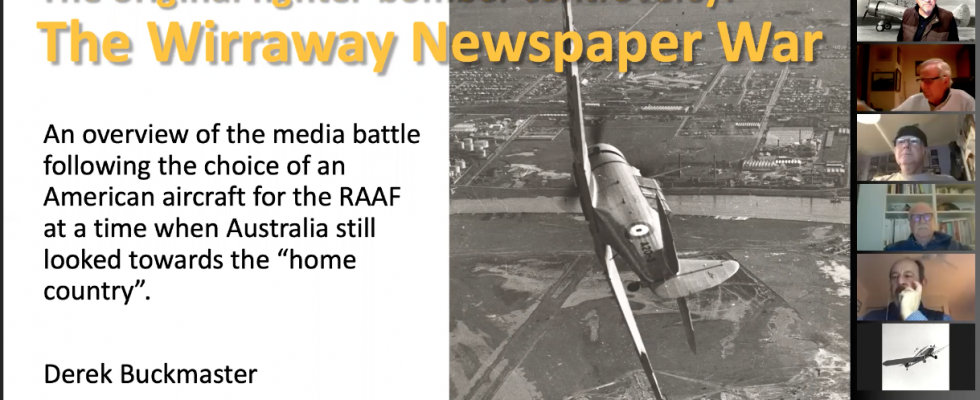
AHSA Monthly Meeting 16 Sep 2020 (Derek Buckmaster: The Wirraway “Newspaper War”)

DerekB16/09/202027/12/2022

Derek Buckmaster gave a presentation on The Wirraway “Newspaper War”.

The AHSA September monthly meeting was held online via Zoom. A recording of the meeting is included below (click the image below to view the video):

  • Twitter
  • Facebook
  • Google+
  • Linkedin
  • Email
Posted inAHSA Meetings CAC
Tagged CAC WirrawayEssington LewisLawrence Wackett

Welcome to the website of the Aviation Historical Society of Australia Inc.
The AHSA is dedicated to recording and promoting Australian aviation history. We find and tell the stories of how aviation (both civil and military) has contributed to the development of Australia and the experiences of Australian people.
To navigate around the site, select from the menu bar above, click on one of the updates below or choose one of the categories below.

On this day in Australian aviation history:

1899 Sir John Patrick Joseph McCauley (1899-1989), air force officer, was born on 18 March 1899 at Newtown, Sydney, son of New South Wales-born parents John Alfred McCauley, clerk, and his wife Sophie Catherine, née Coombe. Educated to Intermediate certificate standard at St Joseph’s College, Hunters Hill, McCauley entered the Royal Military College, Duntroon, Federal Capital Territory, in February 1916. Source: Australian Dictionary of Biography
1910 The first certified flight by a powered heavier-than-air aircraft in Australia was completed by Erich Weiss (also known as Harry Houdini) in a French-built Voisin biplane at Digger's Rest, Victoria on March 18th, 1910. Three flights of around 1 to 3 1/2 minutes duration were made on this date. The flights were certified in writing by nine observers and the Aerial League of Australia awarded Weiss a trophy (disregarding the earlier flights by Defries and Custance). Source: Parnell, N. and Boughton, T., Flypast, A Record of Aviation in Australia, Australian Government Publishing Service, Canberra, 1988.
1973 Piper PA-25-235 Pawnee VH-PEP operated by Tablelands Air Service crashed 11km W of Mudgee, NSW on 18 March 1973. Early in the day the pilot flew the aircraft from Mudgee to the airstrip situated about 4 miles south of the property on which superphosphate was to be spread. The weather was fine, the wind was calm and visibility was unrestricted. Although the pilot did not carry out a ground or aerial inspection of the property prior to commencing operations, nor did he obtain a specific briefing regarding the location of power lines on the property, he had carried out similar operations on this property periodically during the previous five years. As the aircraft approached the power line it banked to the right, apparently to follow the change in boundary direction and the raised left wing tip struck the cables resulting in a portion of the wing leading edge and upper surface fabric being detached. The aircraft slewed and rolled to the left and struck the ground In an inverted attitude 460 feet beyond the power line where it came to rest against a post and wire fence. A fierce fire occurred immediately. There was 1 fatality and the aircraft was destroyed. Source: ATSB
1977 Cessna A188B/A1 AGwagon VH-IEP crashed 5km W of Ingham, Queensland on 18 March 1977. The pilot was authorised to carry out circuits and landings in order to continue his familiarisation with the aircraft type. Weather conditions were fine and the surface wind was light and variable. Several left hand circuits, making touch and go landings on the runway bearing 051 magnetic, were made in sequence with a Cessna 172 aircraft engaged on a similar exercise. At 1615 hours the pilot in command of the Cessna 172, which was then positioned on the base leg of the circuit, advised VH-IEP by radio that he intended to complete his next landing to a full stop. The response from VH-IEP was brief and indistinct but was taken to be an acknowledgement. At this time VH-IEP was observed to be one-half to two-thirds of the way along the downwind leg of a circuit at an estimated height of 700 feet. It was then observed to make a manoeuvre variously described as a slow spin to the right, spinning downwards like a saucer, a spiral dive following a steep turn similar to the commencement of an agricultural spray run. The aircraft struck the ground in a crop of sugar cane in a steep nose down, right wing down attitude heading in a northerly direction. There was 1 fatality and the aircraft was destroyed. Source: ATSB
1987 Peter Wilkins set a record for "Speed over a recognised course" (Powered Aeroplanes, category C-1d "Landplanes: take off weight 1750 to 3000 kg") of 272,72 km/h  on 18 Mar 1987. He was flying a Piper PA-46 Malibu Mirage from Los Angeles, CA (USA) to Sydney, NSW. Source: FAI Records website, ID=14250
2000 Cessna 210E Centurion VH-DNP operated by Kimfam Pty Ltd crashed 2.5 km NNW of Moorabbin Aerodrome, Victoria on 18 March 2000. At the time of the accident, the Cessna 210 was for sale. The pilot had conducted a pre-purchase inspection, including an engine run, the day before the accident. On the day of the accident, the pilot and two passengers boarded the aircraft for an evaluation flight to a nearby aerodrome. Following an uneventful engine run-up, the aircraft was observed to take off from runway 31R and flew for approximately 2.5 km at low level. The pilot subsequently carried out a successful ditching into a water-filled quarry. The pilot and both passengers successfully exited the aircraft but one passenger, who was unable to swim, drowned before reaching land. The investigation found that although the observed performance of the aircraft was consistent with a restriction in the fuel supply system, the reason for the low power output from the engine could not be conclusively determined. Source: ATSB
2008 Pitts S-2A VH-NUK crashed 7 km NE of Camden, NSW on 18 March 2008. The aircraft struck two trees before impacting the ground beside the Northern Road, fatally injuring the occupant of the rear cockpit who was an experienced aerobatic pilot undergoing a routine flight review with an instructor. In the instructor's judgment, the candidate flew well during the flight review until a practice forced landing (PFL) manouvre just before the accident. During the PFL, the candidate stopped responding to instructions and commands, so the instructor took control of the aircraft. A powerful nose-up force began acting on the control column and, despite the instructor's efforts to control the aircraft, it entered an incipient aerodynamic stall. The instructor recovered the aircraft from the stall but, as consequence of the nose-up force, this came too late to prevent a collision with trees. No evidence of any mechanical problem with the aircraft was found. Post mortem examination of the candidate found he had severe heart disease. Expert medical opinion considered it likely that the candidate suffered an incapacitating event as a result of his heart disease, and that the incapacitating event probably led to him exerting a force on the control column. The nose-up force prevented complete control by the instructor, delayed recovery from the stall, and led to the impact with trees. Source: ATSB
2014 A search began in the southern Indian Ocean for the missing MH370 on 18 March 2014. The search was coordinated by the Australian Maritime Safety Authority and lasted from 18 March to 28 April 2014. The surface search, made along an arc determined from analysis of radar and satellite communication data, was undertaken by an international fleet of aircraft and ships with the search areas over this time progressing generally from an initial southwest location along the arc in a north-easterly direction. Malaysian Airlines flight MH370, a Boeing 777-200ER registered 9M-MRO, lost contact with Air Traffic Control during a transition of airspace between Malaysia and Vietnam on 8 March 2014. Source: ATSB
2018 Vans RV-6A VH-OAJ crashed at Somersby Airfield, NSW on 18 March 2018. The pilot was conducting a private flight from Camden to Somersby, New South Wales. During landing, the aircraft initially touched down, then bounced several times, overran the end of the runway, and impacted the side of a watercourse. The aircraft sustained substantial damage. The pilot sustained serious injuries and succumbed to his injuries 2 days later. Source: ATSB
2020 The Australian Deputy Prime Minister and Minister for Infrastructure, Transport and Regional Development Michael McCormack announced on 18 March 2020 a series of measures to support the aviation industry, which was struggling due to a decrease in customer demand and travel restrictions due to the COVID-19 pandemic. . The package involves the refunding and ongoing waiving of a range Government charges on the industry including aviation fuel excise, Airservices charges on domestic airline operations and domestic and regional aviation security charges. The measures were in response to an unprecedented and likely sustained period of falling international and domestic aviation demand related to the impact of COVID-19. The total cost of the measures was estimated to be $715 million, with an upfront estimated benefit of $159 million to airlines for reimbursement of applicable charges paid by domestic airlines since 1 February 2020. “Our response today demonstrates our commitment to supporting the aviation sector as we put Australia in the best position possible to deal with the COVID-19 outbreak,” Mr McCormack said. “Our airlines run on tight budgets at the best of times and these past few weeks have been particularly tough. I’ve been speaking with Australian airline executives every day and will continue to work with them to make sure they receive the support they need. “Providing this assistance not only helps our airlines but also the entire aviation industry, regional Australians in particular and other industries such as tourism and trade, which depend on aviation." Source: Michael McCormack press release

A Mouse At Moresby Ansett Airways Ansett Flying Boat Services Ballarat Bellanca 28/70 Bill Bedford Boeing Brinsmead Bronco CAC CAC Boomerang CAC Ceres CAC Mustang CAC Wackett Trainer CAC Wirraway CAC Woomera Chartair Cyclone Tracy DAP DC-3 DCA DH.50 DH60 Moth Double Sunrise Duigan Memorial Lecture Eric Bonar Essington Lewis Eyre Peninsula Airways GAF Guinea Airways Halestorm JC Fitzmaurice Junkers F13 Lawrence Wackett Macchi Meteor Michael Smith Outlook Percival Proctor Qantas RAF 205 Squadron RFD Winged Target Roy Goon Sid Marshall Target towing

Site Categories:

  • AHSA Info
  • AHSA Journal
  • AHSA Meetings
  • AHSA Videos
  • Archives
  • Aviation history books
  • CAC
  • Events
  • Newsletter

Privacy Policy

Contact Us

Home

Copyright © 2025 Aviation Historical Society of Australia Inc.