Skip to content
  • Home
  • AHSA
    • AHSA Inc. Meetings
    • AHSA Inc
      • AGM 2022
    • AHSA (NSW) Inc.
    • AHSA (QLD) Inc.
    • Privacy Policy
    • Disclaimer
  • Publications
    • Aviation Heritage
    • Aviation Heritage Web Archive
    • AHSA Newsletter Archive
  • Members
    • Members Only
  • Books
  • Join
  • Links
  • Store
  • Log In
    • My Membership Account
Aviation Historical Society of Australia
  • Home
  • AHSA
    • AHSA Inc. Meetings
    • AHSA Inc
      • AGM 2022
    • AHSA (NSW) Inc.
    • AHSA (QLD) Inc.
    • Privacy Policy
    • Disclaimer
  • Publications
    • Aviation Heritage
    • Aviation Heritage Web Archive
    • AHSA Newsletter Archive
  • Members
    • Members Only
  • Books
  • Join
  • Links
  • Store
  • Log In
    • My Membership Account

Tag: Beaufighter

DerekB30/09/202319/11/2023

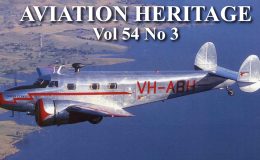
Aviation Heritage Vol. 54 No. 3 (September 2023) Contents Listing

The latest quarterly AHSA journal – Aviation Heritage – has recently been posted to members. The contents of all articles are listed below: Aviation...

Welcome to the website of the Aviation Historical Society of Australia Inc.
The AHSA is dedicated to recording and promoting Australian aviation history. We find and tell the stories of how aviation (both civil and military) has contributed to the development of Australia and the experiences of Australian people.
To navigate around the site, select from the menu bar above, click on one of the updates below or choose one of the categories below.

On this day in Australian aviation history:

1931 Westland Wapiti IIA A5-20 operated by 1 Squadron RAAF crashed at Seymour Airfield, VIC on 26 February 1931. PLTOFF Scoullar, while performing some hedgehopping during an Army Co-operation exercise, struck trees during a low dive and crashed. The aircraft caught fire killing both crew members, PLTOFF Hiram Scoullar (pilot) and AC1 Yourn (observer). Sources: ADF-Serials website and aviation-safety.net website
1942 Warrant Flying Officer Nobuo Fujita and made a long reconnaissance flight over the Victorian coast and suburbs of Melbourne on Thursday 26 February 1942. Taking off before dawn from the Japanese submarine I-25 near Cape Wickham on the northern tip of King Island, Fujita flew north over Bass Strait headed for Cape Otway where he banked to the north east and followed the coastline to the Point Lonsdale lighthouse near the narrow entrance to Port Phillip Bay. He then headed north east towards the city of Melbourne. Fujita struck a few heavy banks of cloud. He flew across the Bellarine Peninsula towards Portarlington. The city of Geelong was 16 kms away to the left of his aircraft on the other side of Lake Connewarre. He was flying NNE as he flew over Portarlington. He then flew another 24 kms along the western edge of Port Phillip Bay. He continued to encounter heavy cloud and was unsure of his position. They eventually dropped down from 1,500 metres into a gap in the clouds. At about 6.45 a.m. Fujita cleared the base of the clouds when he reached 300 metres. They had exited the clouds directly above the RAAF's Laverton airfield. There were about 12 Wirraways based at Laverton along with some Lockheed Hudsons and some Avro Ansons. About nine RAAF personnel at Laverton reported sighting the Japanese aircraft. Two RAAF aircraft were scrambled to try to locate the intruder. They found nothing. Three Wirraways were sent to Bairnsdale. Fujita climbed back into the relative safety of the clouds and headed for Melbourne. He passed over Altona. He used a tactic of dropping down out of the clouds every now and then to make some observations and then climbing back into the clouds for safety. His unexpected descent above RAAF Laverton had made him very nervous about the rest of their flight. The crews of the four ack-ack (anti-aircraft) guns at Williamstown beside the rifle range were in the middle of a routine inspection of their guns when the telescope person spotted the aircraft identifying it as a Japanese aircraft. Aubrey Auton from Melbourne, spotted the prominent red roundel. The roundel was easy to spot as the aircraft was flying so slow and was very low. The Lieutenant in charge of the gun battery unfortunately did not give the order to open fire. Instead he got on the phone to headquarters to obtain permission. By that time it was too late. Fujita turned right and headed across the rifle range butts towards Port Phillip Bay. Fujita continued his journey across Melbourne at a height of 300 metres obtaining a birds eye view of the Yarra River, the central business district of Melbourne and the docks at the mouth of the Yarra River. He spotted a number of docks along the river used to repair ships. The other thing that struck him was the red, green and yellow roof tiles on all the houses and the beautiful countryside and the large flocks of sheep. Fujita continued southwards over St. Kilda, Brighton and Sandringham. He then turned towards Frankston. Okuda, with the canopy back, spotted 19 vessels anchored in the harbour through his binoculars. He also spotted 6 warships headed in single file towards the Port Melbourne dock area. Fujita confirmed through his binoculars that the leading ship was a light cruiser, and the others were all destroyers. Fujita crossed the shore again near Dromona and continued on towards Cape Schanck where he was able to re-establish his position via the Cape Schanck lighthouse. He then set a direct 175 kms course for the Cape Wickham lighthouse. He spotted the submarine only 6 nautical miles east of the lighthouse. It had drifted 4 nautical miles closer to the lighthouse since they first took off. Source: Ozatwar.com website
1997 Hughes 369HS VH-XAX operated by Heli-Zec crashed beside the MV Cape Arnhem, 32 km E of Gladstone, QLD on 26 February 1997. The helicopter was involved in a ship-to-shore transfer of a marine pilot at night and had just taken off from the Cape Arnhem when the rotor struck part of the ship - the pilot believed the ship's crane was swung into the rotor arc. There was 1 fatality (the sole passenger) and the helicopter was destroyed. Sources: ATSB website and aviation-safety.net website
1998 CASA, through AirServices Australia, introduced a radar-controlled Class E airspace trial, to replace Class G for six months on 26 February 1998. It required transponders to be fitted to all aircraft using the region. Source: Australian, 27 March 1998; CASA, 28 August 1997. via aph.gov.au website
1998 Cessna 210N VH-SJP crashed at Osborne Mine, QLD on 26 February 1998. There were 3 fatalities and the aircraft was written off. Source: aviation-safety.net website
1998 The Civil Aviation Safety Authority (CASA), through Air Services Australia, introduced a radar-controlled Class E airspace trial, to replace Class G for six months on 26 February 1998. It required transponders to be fitted to all aircraft using the region. Source: aph.gov.au website
2008 At about 0930 Eastern Daylight-saving Time on 26 February 2008, an Air Tractor Inc. 502, registered VH-CJK (CJK) that was aerial spraying 10 km north-east of Wee Waa, New South Wales and an Air Tractor Inc. 502B, registered VH-ATB (ATB) that had just departed from a nearby airstrip, collided at about 200 ft above ground level. The pilot of CJK was fatally injured and the pilot of ATB was seriously injured. Both aircraft were seriously damaged. Neither pilot was aware of the other aircraft and, although visibility at the time of the accident was reported as 'good', either one or both pilots did not see the other aircraft in sufficient time to avoid a collision. Sources: ATSB website and aviation-safety.net website
2021 The Civil Aviation Safety Authority (CASA) announced that it had lifted a ban on Boeing’s 737 MAX jet on 26 February 2021. The 737 Max had been grounded for almost two years following two crashes that killed almost 350 people and led to a serious shake-up in Boeing’s leadership as well as billions of dollars in losses. While no Australian airlines operated the Boeing 737 Max at the time, two foreign airlines flew these aircraft types to Australia before the COVID-19 pandemic – Singapore-based SilkAir (now integrated into parent Singapore Airlines) and Fiji Airways. Source: Asian Aviation website

Ansett Flying Boat Services Ballarat Beaufighter Bellanca 28/70 Bill Bedford Boeing Brinsmead Bronco CAC CAC Boomerang CAC Ceres CAC Mustang CAC Wackett Trainer CAC Wirraway CAC Woomera Chartair Cyclone Tracy DAP DC-3 DCA DH.50 DH60 Moth Duigan Memorial Lecture Eric Bonar Essington Lewis Eyre Peninsula Airways GAF Guinea Airways Halestorm JC Fitzmaurice Junkers F13 Lawrence Wackett Macchi Meteor Michael Smith Outlook Percival Proctor Qantas RAF 205 Squadron RFD Winged Target Roy Goon Sid Marshall Smithy (movie) Supermarine Southampton Target towing

Site Categories:

  • AHSA Info
  • AHSA Journal
  • AHSA Meetings
  • AHSA Videos
  • Archives
  • Aviation history books
  • CAC
  • Events
  • Newsletter

Privacy Policy

Contact Us

Home

Copyright © 2025 Aviation Historical Society of Australia Inc.