Skip to content
  • Home
  • AHSA
    • AHSA Inc. Meetings
    • AHSA Inc
      • AGM 2022
    • AHSA (NSW) Inc.
    • AHSA (QLD) Inc.
    • Privacy Policy
    • Disclaimer
  • Publications
    • Aviation Heritage
    • Aviation Heritage Web Archive
    • AHSA Newsletter Archive
  • Members
    • Members Only
  • Books
  • Join
  • Links
  • Store
  • Log In
    • My Membership Account
Aviation Historical Society of Australia
  • Home
  • AHSA
    • AHSA Inc. Meetings
    • AHSA Inc
      • AGM 2022
    • AHSA (NSW) Inc.
    • AHSA (QLD) Inc.
    • Privacy Policy
    • Disclaimer
  • Publications
    • Aviation Heritage
    • Aviation Heritage Web Archive
    • AHSA Newsletter Archive
  • Members
    • Members Only
  • Books
  • Join
  • Links
  • Store
  • Log In
    • My Membership Account

Tag: Smithy (movie)

DerekB30/09/202319/11/2023

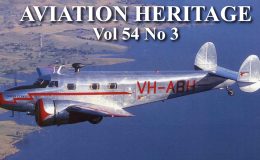
Aviation Heritage Vol. 54 No. 3 (September 2023) Contents Listing

The latest quarterly AHSA journal – Aviation Heritage – has recently been posted to members. The contents of all articles are listed below: Aviation...

Welcome to the website of the Aviation Historical Society of Australia Inc.
The AHSA is dedicated to recording and promoting Australian aviation history. We find and tell the stories of how aviation (both civil and military) has contributed to the development of Australia and the experiences of Australian people.
To navigate around the site, select from the menu bar above, click on one of the updates below or choose one of the categories below.

On this day in Australian aviation history:

1910 After four days of assembly, preparation and taxying tests, Fred Custance made two flights in Bleriot XI monoplane No. 37 on 17 March 1910 at Bolivar, north of Adelaide, SA. Fred Jones (the owner of the aircraft) reported that the first flight, which took place around 5:00am, circled around and lasted 5 minutes and 25 seconds. The second flight was shorter, and the aircraft flew in a straight line before making a heavy landing in which the aircraft was damaged. Due to a lack of independent witnesses these two flights were not officially recognised at the time. In 1957 the Bleriot’s owner, Fred Jones, wrote to his engineer, Bill Wittber, confessing that the claimed "circling" flight of March 17th was a “myth” and Custance’s second flight attempt was a take off followed by a crash slightly injuring Custance and damaging the Bleriot. However the second flight meets the criteria of flight established by the Gorell Committee on behalf of the Aero Club of Great Britain, and so should be accepted as a valid flight. Sources: Parnell, N. and Boughton, T., Flypast, A Record of Aviation in Australia, Australian Government Publishing Service, Canberra, 1988; Debenham, Ian, First Powered Flight in Australia- Episode 4, 9 December 2009, Museum of Applied Arts and Sciences.
1942 On the 17 March 1942 the Duty Officer at RAAF Pearce informed GPCAPT Paddy Hefferman that a number of wooden aircraft cases had arrived at the nearby Bullsbrook railway siding from the Port of Fremantle. It was assumed at the time that these boxes contained Kittyhawk fighters intended to re-equip No 77 Squadron, RAAF as 19 P-40Es were being offloaded from the SS Robin Tuxworth (USA) at the time. When it was discovered that the crates in fact contained Swordfish, Hefferman decided to have the aircraft assembled by SGT Wright, who had experience on Wapiti aircraft though no handbooks accompanied the crates. GPCAPT Hefferman flew the first of the assembled aircraft and the aircraft are known to have been operated by 14 Squadron and No 25 Squadron as well as RAAF Pearce Station Headquarters (SHQ). No 25 Squadron operated at least three of the aircraft on anti-submarine patrols around Rottnest Island and Gage Roads off the Port of Fremantle. All squadron pilots converted to the Swordfish but it appears that Sergeant Coulter amassed the greatest number of hours while another Sergeant Dudley Irwin (Navigator) later became Minister of Air in the Australian Federal Government of John Gorton in 1969. No 14 Squadron was also allocated Swordfish for communications work and regularly flew between Pearce and Squadron detachments based at Busselton, Cunderdin and Carnarvon. RAAF Pearce Station Headquarters also appears to have used a Swordfish as a flight to Cunderdin on the 27 March 1942 flown by GPCAPT Hefferman, FLTLT Kirkman and FLGOFF Kimpton was recorded. Officialdom eventually caught up with the Station's unofficial fleet of Swordfish when RAAF Headquarters in Melbourne gave orders to have the aircraft disassembled and re-crated for forwarding to their appropriate recipients. Source: ADF-Serials
1944 CAC CA-12 Boomerang A46-48 of 5 Squadron RAAF crashed 20km north of Biboohra, Queensland on 17 March 1944. The aircraft was on an Army artillery shoot exercise. The pilot FLGOFF William Kenneth Thompson (409351) died in the crash. Sources: ADF-Serials; aviation-safety.net website
1957 Gloster Meteor U.15 Drone VW273 operated by 1 Air Trials Unit, Woomera crashed at The Pines near Woomera, SA on 17 March 1957. According to an eyewitness report, the aircraft tracked low to the east of the town trailing smoke. It struck higher ground and exploded with a large plume of smoke. WOFF Murray, 1 ATU, said that there had been a fatality. In the next couple of days there were very large emu parades over the flight path looking for engine detritus as it was rumoured that a engine exploded on lift off. There was 1 fatality and the aircraft was destroyed. Source: aviation-safety.net website
1959 Four months after he passed away, the ashes of Sir Hubert Wilkins, polar explorer, war correspondent, aviator and photographer, were scattered at the North Pole by the crew of the nuclear submarine USS Skate on 17 March 1959. Sources: Jeff Maynard, The Illustrated Sir Hubert Wilkins, Netfield Publishing, 2022; Australian Dictionary of Biography
1970 Fletcher FU24 VH-FBC operated by Westair Aviation Service Pty Ltd crashed at Cassilis, NSW on 17 March 1970. The aircraft had been engaged in spreading operations during the morning and after a meal break, the aircraft was re-loaded and refuelled. At about 1500 hours the pilot began spreading superphosphate over selected areas either side of a low ridge in gently undulating country. In fine and calm weather conditions the spreading runs were made in a left hand pattern with a run in a north-easterly direction over one area and continuing in the pattern for a run in a south-westerly direction over the other areas while gradually working upslope towards the central ridge area. After making a run to the north-east the pilot commenced a turn to the left to position the aircraft for a run to the south-west and it was then seen to dive steeply toward the ground while dumping its load. The aircraft struck the ground in a right wing down attitude and came to rest about 105 feet from the initial Impact point. An examination of the wreckage disclosed that the engine was under power at the time of the impact, and that the flaps were extended, probably at the 40 degree position. The cause of the accident has not been determined but a possible explanation is that the pilot lost control of the aircraft while endeavouring to turn the aircraft tightly in order to achieve his planned flight path. There was 1 fatality and the aircraft was written off. Sources: ATSB; aviation-safety.net website
1973 Piper PA-25-235B Pawnee VH-KLE operated by Les Keys Aviation Pty Ltd crashed at near Jandowae, QLD on 17 March 1973. The pilot was spraying a crop of sorghum. The pilot made a brief aerial inspection and commenced operations running north-east and south-west alternately. On each of the first three runs in each direction the aircraft passed under the power line and the circumstances suggest that the pilot was aware of its presence. The seventh run was made towards the north-east and, at its completion, the aircraft commenced to pull in the vicinity of the boundary fence which was earlier than on previous runs. The aircraft then struck the power wire in a nose up, port wing down attitude. The wire became caught on a flood light which was mounted on the underside of the port wing. The aircraft veered sharply to the left before the wire wrenched out the light and the internal wing drag strut assembly on which the light was mounted. The aircraft continued rolling to the left as it climbed to a height of about 50 feet and it then dived into the ground in an inverted steep nose down attitude and burst into flames. There was 1 fatality and the aircraft was destroyed. Sources: ATSB; aviation-safety.net website
1974 Cessna 182Q VH-EQU operated by Darwin Parachute Club crashed at Batchelor Airstrip, Northern Territory on 17 March 1974. At 1627 hours the wreckage of VH-EQU was located in an area of relatively dense timber 137 metres beyond and 91 metres to the left of the end of Runway 14 at Batchelor. The aircraft had struck the ground at a relatively low speed whilst in a steep nose down, left wing down attitude. The evidence indicates that the aircraft sustained a substantial, but unexplained, loss of power at a low height after take off. There were 2 fatalities and the aircraft was written off. Sources: ATSB; aviation-safety.net website
2013 Amateur-built scale-replica Supermarine Spitfire Mk XXVI VH-VSF crashed near Parafield Airport, north of Adelaide, SA on 17 March 2013. The aircraft was participating in an air display at Parafield Airport. The pilot performed a number of airborne passes above the runways in various directions and completed the display with a slow speed pass at 400 ft with the landing gear and some wing flap extended. Towards the end of this pass the pilot radioed the tower to coordinate a landing and accepted runway 21 Left with an 11 kt crosswind. By now the pilot had turned right and the Spitfire was near the extended runway centreline and 1 km from the runway threshold at a slow speed. A left turn was then observed and, soon after, a wing dropped and the aircraft entered a steep descent. The aircraft crashed in a factory car park, fatally injuring the pilot and substantially damaging the aircraft. Sources: ATSB; aviation-safety.net website
2017 Just over a year after issuing a joint Request for Information, Alliance partners Virgin Australia and Air New Zealand announced the findings of their investigation into commercially viable biofuel sources within Australasia on 16 March 2017. In March 2016, Air New Zealand and Virgin Australia issued a joint Request for Information (RFI) to the market to investigate options for locally produced aviation biofuel. The airlines have now completed an extensive review of more than 30 responses received from organisations in Australia, New Zealand, the US, Canada and Europe. Air New Zealand and Virgin Australia will now work with short-listed companies on strengthening the commercial case for investment. Air New Zealand Head of Sustainability Lisa Daniell says the airlines achieved their key objectives in testing market readiness and gaining a better understanding of potential supply opportunities. “The RFI has helped stimulate industry dialogue on the production of sustainable aviation fuel in the Australasian region. Importantly, the process has also greatly expanded our understanding of the technologies and processes involved and the potential timeframes to scale up to the volumes required,” says Ms Daniell. Virgin Australia Head of Sustainability Robert Wood says: “There is clear interest and potential to produce sustainable aviation fuel in this region, and we will now undertake further detailed exploration in order to reach significant commercial scale. We remain optimistic about the potential of biofuel to achieve significant carbon emissions reductions in the medium-term.” Source: Virgin Australia newsroom

A Mouse At Moresby Ansett Airways Ansett Flying Boat Services Ballarat Bellanca 28/70 Bill Bedford Boeing Brinsmead Bronco CAC CAC Boomerang CAC Ceres CAC Mustang CAC Wackett Trainer CAC Wirraway CAC Woomera Chartair Cyclone Tracy DAP DC-3 DCA DH.50 DH60 Moth Double Sunrise Duigan Memorial Lecture Eric Bonar Essington Lewis Eyre Peninsula Airways GAF Guinea Airways Halestorm JC Fitzmaurice Junkers F13 Lawrence Wackett Macchi Meteor Michael Smith Outlook Percival Proctor Qantas RAF 205 Squadron RFD Winged Target Roy Goon Sid Marshall Target towing

Site Categories:

  • AHSA Info
  • AHSA Journal
  • AHSA Meetings
  • AHSA Videos
  • Archives
  • Aviation history books
  • CAC
  • Events
  • Newsletter

Privacy Policy

Contact Us

Home

Copyright © 2025 Aviation Historical Society of Australia Inc.