Skip to content
  • Home
  • AHSA
    • AHSA Inc. Meetings
    • AHSA Inc
      • AGM 2022
    • AHSA (NSW) Inc.
    • AHSA (QLD) Inc.
    • Privacy Policy
    • Disclaimer
  • Publications
    • Aviation Heritage
    • Aviation Heritage Web Archive
    • AHSA Newsletter Archive
  • Members
    • Members Only
  • Books
  • Join
  • Links
  • Store
  • Log In
    • My Membership Account
Aviation Historical Society of Australia
  • Home
  • AHSA
    • AHSA Inc. Meetings
    • AHSA Inc
      • AGM 2022
    • AHSA (NSW) Inc.
    • AHSA (QLD) Inc.
    • Privacy Policy
    • Disclaimer
  • Publications
    • Aviation Heritage
    • Aviation Heritage Web Archive
    • AHSA Newsletter Archive
  • Members
    • Members Only
  • Books
  • Join
  • Links
  • Store
  • Log In
    • My Membership Account

Tag: Supermarine Southampton

DerekB06/03/202303/06/2023

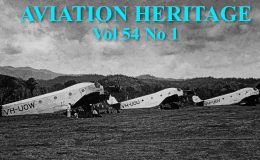
Aviation Heritage Vol. 54 No. 1 (March 2023) Contents Listing

The latest quarterly edition (March 2023) of the AHSA journal – Aviation Heritage – has recently been posted to members. The full contents are...

Welcome to the website of the Aviation Historical Society of Australia Inc.
The AHSA is dedicated to recording and promoting Australian aviation history. We find and tell the stories of how aviation (both civil and military) has contributed to the development of Australia and the experiences of Australian people.
To navigate around the site, select from the menu bar above, click on one of the updates below or choose one of the categories below.

On this day in Australian aviation history:

1966 Vickers 832 Viscount VH-RMI of Ansett ANA crashed at Nadjayamba Station, Queensland approximately 12 miles west of Winton township and about 13.5 miles short of the airfield. The port wing of the aircraft failed in flight, caused by a fire in the No. 2 cabin air blower which spread to a fuel tank in the wing where the upper boom of the main spar was heated until it failed under normal flight loads. There were 24 fatalities in the crash. Source: Macarthur Job, The Small Seeds of Disaster - the Crash of Viscount VH-RMI at Winton, 22 September 1966, Aviation Heritage Vol 41 No 4 December 2010
1987 The first production version of the Ligeti Aero-Nautical Stratos Mk. II ultralight aircraft crashed 1km south-east of Penfield, Victoria on 22 September 1987, killing the pilot and designer Charles Ligeti. This aircraft was intended to be the production version of the "Stratos" aircraft. The prototype version (Mk. I) had successfully flown some 340 hours. The production model (Mk. II) incorporated significant changes made by the designer/pilot. These changes included the removal of the dihedral from the main wing and the use of full span elevators on the canard wing and full span ailerons on the main wing. The engine mounting was lowered such that the ducted propeller was totally below the main wing and the lower part of the propeller duct was extended well forward to form a "channel or strake". The main purpose of the "channel wing" was an attempt by the designer to lower the stall speed of the aircraft to 30 knots and to reduce both landing and takeoff speeds and distances. As far as the investigation could determine, the effect of these modifications had not been checked by wind tunnel or other methods prior to this flight. On the day of the accident the pilot and his assistants had worked at the factory preparing the aircraft for testing. The preparation included a determination of the centre of gravity, although no record was kept of these calculations. Following these preparations the aircraft was loaded onto a trailer and taken to Penfield. The weather conditions at the time were fine, with light winds. The pilot subsequently carried out a series of taxying tests, to establish the optimum position for the control column. He then conducted a take-off, and operated in the local area for about 17 minutes. Witnesses reported that the aircraft then carried out a very slow pass over the aerodrome at a height of between 400 and 500 feet above ground level. About one minute later it was seen to turn back towards the strip. However, shortly after the turn was completed, control of the aircraft was evidently lost. It is uncertain whether the aircraft suddenly pitched nose up or nose down, but all witnesses agreed that it then fell vertically while the nose swung in a pendulous motion. The aircraft struck the ground in an inverted attitude with little or no horizontal speed. An inspection of the aircraft found that all airframe components were essentially intact and there was no indication of any airframe or control failure prior to ground impact. The engine was test run and strip inspected and no fault could be found. No aerodynamic testing was carried out on the airframe to determine the likely effect on performance of the various modifications made to this aircraft. However, given that the prototype appeared to suffer no adverse flying characteristics, it is possible that the modifications incorporated in the new aircraft had an adverse effect on the stall characteristics. Analysis of the modifications indicates that the most significant effect on the stall characteristics would have resulted from use of full span elevators on the canard wing. The use of full span elevators results in a relatively uniform loading of the canard as the elevator is deflected approaching the stall. The result is that the canard would be developing more lift, compared to the same wing without full span elevators, before the wing stalled and the stall would be sharper. Because the main wing is still producing lift at this stage the nose down pitch following the stall of the canard would be aggravated. It is considered likely that the accident sequence was initiated by a full canard stall followed by a rapid nose down pitch. Also, the altitude at which the flight was conducted would not have allowed the pilot time to make the necessary corrective control imputs following the stall before the aircraft impacted the ground. The damaged aircraft was repaired and is on display at the Ballarat Air Museum, Victoria. Sources: ATSB Aviation Safety Investigation Report 198701462; Ron Ligeti via Recreationalflying.com

A Mouse At Moresby Ansett Airways Ansett Flying Boat Services Ballarat Bellanca 28/70 Bill Bedford Boeing Brinsmead Bronco CAC CAC Boomerang CAC Ceres CAC Mustang CAC Wackett Trainer CAC Wirraway CAC Woomera Chartair Cyclone Tracy DAP DC-3 DCA DH.50 DH60 Moth Double Sunrise Duigan Memorial Lecture Eric Bonar Essington Lewis Eyre Peninsula Airways GAF Guinea Airways Halestorm JC Fitzmaurice Junkers F13 Lawrence Wackett Macchi Meteor Michael Smith Outlook Percival Proctor Qantas RAF 205 Squadron RFD Winged Target Roy Goon Sid Marshall Target towing

Site Categories:

  • AHSA Info
  • AHSA Journal
  • AHSA Meetings
  • AHSA Videos
  • Archives
  • Aviation history books
  • CAC
  • Events
  • Newsletter

Privacy Policy

Contact Us

Home

Copyright © 2025 Aviation Historical Society of Australia Inc.