Skip to content
  • Home
  • AHSA
    • AHSA Inc. Meetings
    • AHSA Inc
      • AGM 2022
    • AHSA (NSW) Inc.
    • AHSA (QLD) Inc.
    • Privacy Policy
    • Disclaimer
  • Publications
    • Aviation Heritage
    • Aviation Heritage Web Archive
    • AHSA Newsletter Archive
  • Members
    • Members Only
  • Books
  • Join
  • Links
  • Store
  • Log In
    • My Membership Account
Aviation Historical Society of Australia
  • Home
  • AHSA
    • AHSA Inc. Meetings
    • AHSA Inc
      • AGM 2022
    • AHSA (NSW) Inc.
    • AHSA (QLD) Inc.
    • Privacy Policy
    • Disclaimer
  • Publications
    • Aviation Heritage
    • Aviation Heritage Web Archive
    • AHSA Newsletter Archive
  • Members
    • Members Only
  • Books
  • Join
  • Links
  • Store
  • Log In
    • My Membership Account

Category: AHSA Journal

Aviation Heritage is the quarterly journal of the Aviation Historical Society of Australia. It contains high-quality and well-researched articles covering the history of Australian aviation, including Australians overseas. It is available to members of the AHSA.
Selected back-issues can be purchased from the web store on this site.
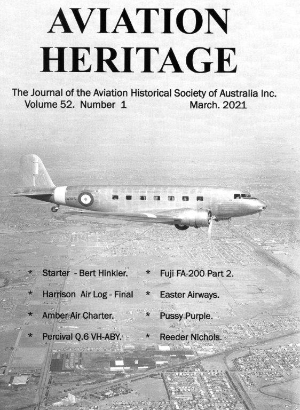
DerekB01/03/202126/04/2021

Aviation Heritage Volume 52 Number 1 contents listing

The latest quarterly edition (March 2021) of the AHSA journal – Aviation Heritage – has recently been posted to members. The full contents are...
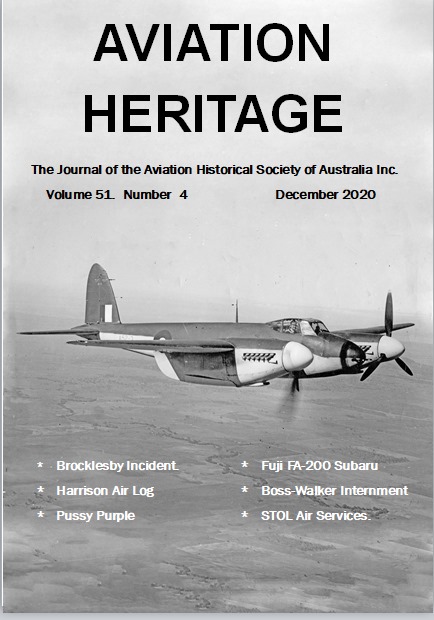
Cover image: Aviation Heritage Vol 51 No 4
DerekB01/12/202026/04/2021

Aviation Heritage Volume 51 Number 4 contents listing

The latest quarterly edition (December 2020) of the AHSA journal - Aviation Heritage - has recently been posted to members. Full contents are listed...
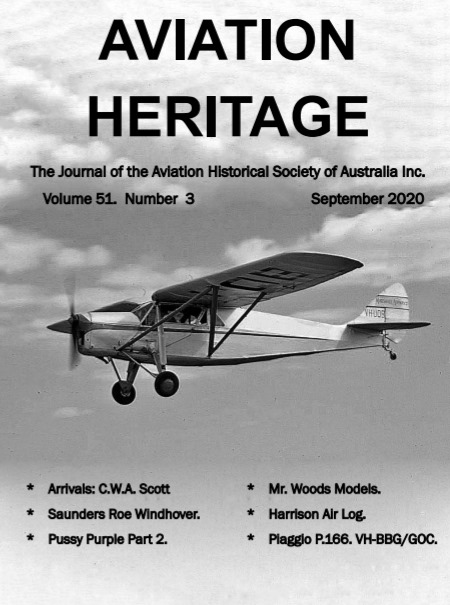
Cover image: Aviation Heritage Vol 51 No 3
DerekB01/09/202026/04/2021

Aviation Heritage Volume 51 Number 3 contents listing

The latest quarterly edition (September 2020) of the AHSA journal - Aviation Heritage - has recently been hosted to members. Full contents listing: Aviation...
DerekB30/06/202021/12/2021

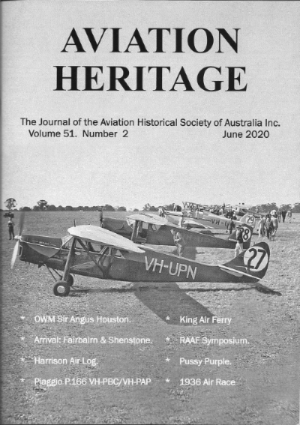
Aviation Heritage Volume 51 Number 2 contents listing

The latest quarterly edition (June 2020) of the AHSA journal - Aviation Heritage - has been posted to members. Full contents listing: Aviation Heritage...
DerekB01/03/202021/12/2021

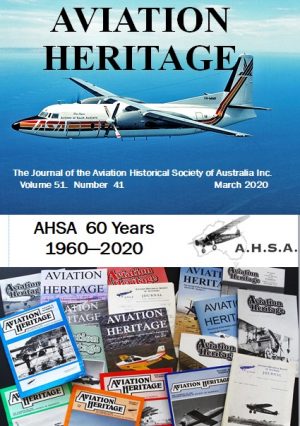
Aviation Heritage Volume 51 Number 1 contents listing

The latest quarterly edition (March 2020) of the AHSA journal - Aviation Heritage - has recently been posted to members. Full contents listing: Aviation...
Cover image: Aviation Heritage v50 n1
DerekB01/12/201926/04/2021

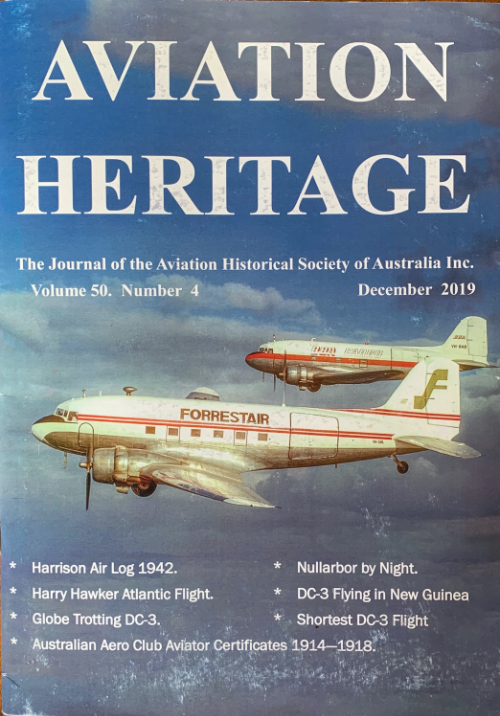
Aviation Heritage Volume 50 Number 4 contents listing

The latest edition (December 2019) of the AHSA journal - Aviation Heritage - has recently been posted to members. A complete listing of contents...
DerekB01/03/201928/12/2021

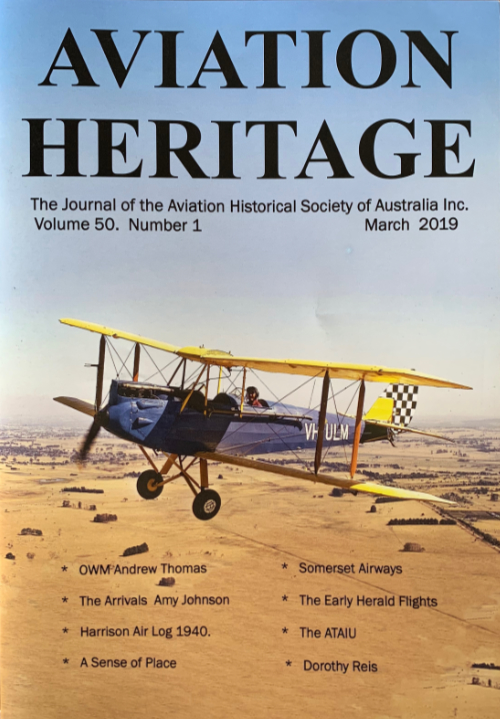
Aviation Heritage Volume 50 Number 1 Contents Listing

The latest quarterly edition (March 2019) of the AHSA journal - Aviation Heritage - has recently been posted to members. The full contents are...

Posts pagination

Page 1 Page 2

Welcome to the website of the Aviation Historical Society of Australia Inc.
The AHSA is dedicated to recording and promoting Australian aviation history. We find and tell the stories of how aviation (both civil and military) has contributed to the development of Australia and the experiences of Australian people.
To navigate around the site, select from the menu bar above, click on one of the updates below or choose one of the categories below.

On this day in Australian aviation history:

1926 The British aviator Alan Cobham arrived in London, England on 1 October 1926 after completing an around-trip to Australia. He flew the de Havilland D.H. 50J, G-EBFO for the entire trip, the first time that an aircraft had flown from England to Australia and returned. The aircraft was later sold to Western Australian Airlines. Source: National Film & Sound Archive
1942 No. 1 Rescue and Communication Squadron Royal Australian Air Force was raised on 1 October 1942 at Port Moresby under the command of SQNLDR Jerry Pentland - a World War I veteran who was considered the oldest pilot in the RAAF at the time, and who had extensive experience operating in New Guinea. Initially formed as a single flight, the unit was expanded to a full squadron in November 1942. The Squadron operated for around a year, serving in the New Guinea campaign. The Squadron was based at various locations around New Guinea, including Goodenough Island, and mainland airfields such as Vailala, Kerma, Amau, Dobodura, Gurney and Garaina. Crews often operated from remote airfields, dropping supplies to Australian troops around Milne Bay; evacuating civilians from remote areas in the northern highlands; evacuating wounded soldiers from locations as far afield as Buin as well as along the Kokoda Track; and rescuing downed Australian and US airmen. Sources: NAA: A9186, 370 "RAAF Unit History sheets (Form A50) [Operations Record Book - Forms A50 and A51] 1 Rescue and Communication Unit Nov 42 - Nov 43"; RAAF Historical Section, Units of the Royal Australian Air Force, p. 186
2012 de Havilland DH-84 Dragon Mk 2 VH-UXG crashed near Borumba Dam, South of Gympie, Queensland on 1 October 2012. At about 1107 hours the pilot-owner of the restored vintage Dragon, took off on a private flight from Monto to Caboolture, Queensland. On board with the pilot were five passengers, baggage and equipment. The pilot was not qualified for instrument flight and the aircraft not equipped for instrument flight. The weather on the coast and extending inland included low clouds and rain. At 1315, the pilot radioed air traffic control (ATC) and requested navigation assistance, advising that the aircraft was in cloud. Over the next 50 minutes ATC provided assistance to the pilot and a search and rescue (SAR) helicopter was dispatched to the area. From the pilot’s radio calls it was apparent that he was unable to navigate clear of the cloud. Radio contact was intermittent and no transmissions from the aircraft were received after 1405. An extensive search was initiated, and the aircraft wreckage was located on 3 October in high terrain. The aircraft was destroyed and there were no survivors. The ATSB found that with no or limited visual references available in and near cloud, it would have been very difficult for the pilot to maintain control of the aircraft. After maintaining control in such conditions for about an hour, and being unable to navigate away from the mountain range, the pilot most likely became spatially disoriented and lost control of the aircraft before it impacted the ground. Due to the limited radio and radar coverage in the area, the ability of ATC and the SAR helicopter to assist was limited. However, the ATSB found that there were areas of potential improvement in the management of in-flight emergencies and coordination between ATC and SAR aircraft. Sources: ATSB investigation number AO-2012-130; aviation-safety.net website

A Mouse At Moresby Ansett Airways Ansett Flying Boat Services Ballarat Bellanca 28/70 Bill Bedford Boeing Brinsmead Bronco CAC CAC Boomerang CAC Ceres CAC Mustang CAC Wackett Trainer CAC Wirraway CAC Woomera Chartair Cyclone Tracy DAP DC-3 DCA DH.50 DH60 Moth Double Sunrise Duigan Memorial Lecture Eric Bonar Essington Lewis Eyre Peninsula Airways GAF Guinea Airways Halestorm JC Fitzmaurice Junkers F13 Lawrence Wackett Macchi Meteor Michael Smith Outlook Percival Proctor Qantas RAF 205 Squadron RFD Winged Target Roy Goon Sid Marshall Target towing

Site Categories:

  • AHSA Info
  • AHSA Journal
  • AHSA Meetings
  • AHSA Videos
  • Archives
  • Aviation history books
  • CAC
  • Events
  • Newsletter

Privacy Policy

Contact Us

Home

Copyright © 2025 Aviation Historical Society of Australia Inc.